What to Look for in a Commercial Outdoor Dining Table in 2026

The outdoor dining furniture market is projected by industry analysts to see strong growth through the end of the decade, driven by the continued expansion of al fresco hospitality. Yet many operators overlook the hidden cost of budget furniture. As a rough illustration: a table set purchased for $800 that needs replacement every two years costs about $400 annually, while a $3,000 set that lasts twelve years averages $250 per year. The ideal commercial outdoor dining table balances durability, functionality, style, and regulatory compliance. This guide examines material performance, sizing standards, design trends, and accessibility requirements to help buyers make a confident, long-term investment.
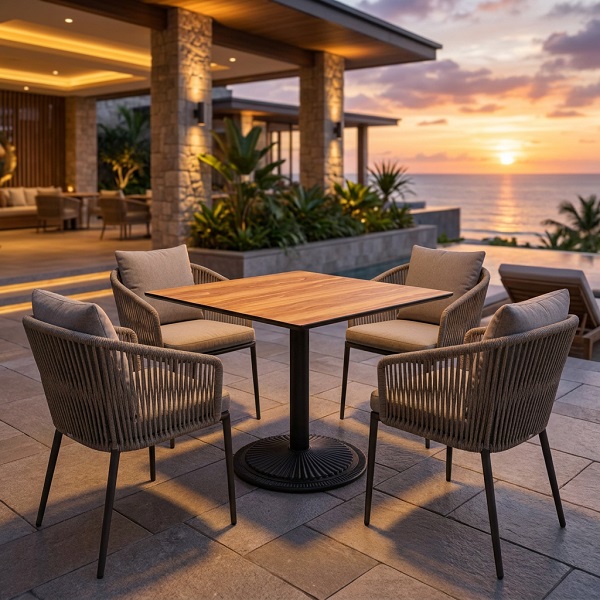
HPL tabletops offer a durable, low-maintenance surface for high-traffic outdoor dining areas.
Use the 24-inch clearance rule to plan comfortable seating and efficient traffic flow.
Match table height and shape to your restaurant concept — standard, bar-height, round, or rectangular.
Select colors and finishes that align with your brand identity and perform well outdoors.
Ensure at least 5% of dining surfaces meet ADA accessibility standards (28–34 inch height, 27-inch knee clearance).
Invest in quality to reduce replacement frequency — calculate total cost of ownership, not just upfront price.
Check warranty terms — commercial use coverage and UV fading exclusions matter.
Custom sizes and OEM options allow tables to fit your exact patio layout.
HPL Thickness
Clearance Rule
Material Standard
Service Life
Durable Materials for Outdoor Restaurant Tables
Selecting the right material for an outdoor restaurant table determines its lifespan, safety, and total cost of ownership. Operators often choose wood for its classic appearance or metal for an industrial aesthetic. Both options carry ongoing maintenance requirements. High-pressure laminate (HPL) has become a widely specified choice for commercial outdoor tables, offering a combination of impact resistance, weather performance, and low upkeep that traditional materials struggle to match.
Why HPL Performs Well Against Wood and Metal
Compact HPL panels achieve a density typically between 1,350 and 1,500 kg/m³, which is significantly higher than solid wood. This density contributes to impact resistance — a dropped tray or a bumped chair is less likely to dent or scratch the surface. Flexural strength for high-density compact HPL generally ranges from 80 to 120 MPa depending on formulation, helping the tabletop remain rigid under load without sagging.
The manufacturing process follows EN 438 standards, which define test methods and classification for high-pressure decorative laminates. Exterior-grade compact laminates are covered specifically by EN 438-6, which sets requirements for products intended for outdoor weather conditions including direct sunlight, rain, and frost. Products meeting these standards undergo testing for UV resistance, impact performance, and dimensional stability.
| Material | Weather Resistance | Maintenance | Typical Lifespan (Commercial) |
|---|---|---|---|
| Compact HPL (Exterior Grade) | High — non-porous, UV-stabilized | Low — wipe clean | 10–15 years |
| Solid Wood (Teak, etc.) | Moderate — requires sealing | High — oiling, sanding | 10–20 years (with care) |
| Powder-Coated Metal | Moderate — coating can chip | Medium — touch-up paint | 5–10 years |
| MDF / Particleboard | Low — swells with moisture | Very high — frequent replacement | 2–4 years |
Weather Resistance and UV Stability
Outdoor dining table materials face constant exposure to sunlight, rain, and temperature swings. Wood warps and cracks as moisture levels change. Metal corrodes when protective coatings fail. HPL resists these issues through its dense, non-porous construction. Dimensional stability testing typically shows thickness variation below 0.3% due to humidity changes, meaning the tabletop will not warp, swell, or shrink significantly under normal outdoor exposure.
UV stability is another critical factor. Under EN 438-2 (test methods for HPL properties), clause 29 covers resistance to artificial weathering including light fastness, and clause 28 covers resistance to UV light. Quality exterior-grade HPL panels maintain their appearance with minimal fading — commonly achieving a grey scale rating of 4–5 and a color change value below 5 after accelerated testing. This helps restaurant owners avoid the patchy, sun-bleached appearance that makes a patio look neglected.
Easy Maintenance for High-Traffic Areas
Maintenance costs often exceed the initial purchase price over a furniture's lifetime. Wood requires periodic sealing, staining, and sanding. Metal needs rust prevention and touch-up painting. HPL eliminates these tasks. A simple wipe with clean water and a soft cloth removes most stains. The non-porous surface resists common chemicals, oils, and food residue without absorbing them.
This easy cleanup saves significant labor hours each week. Staff can sanitize tables quickly between seatings, keeping the patio ready for the next guests. The smooth surface also supports hygiene in food service areas. For busy establishments, the time savings alone can justify choosing HPL over traditional materials.
Table Bases: Cast Iron vs. Aluminum
The tabletop receives the most attention, but the base carries the structural load. Two materials dominate the commercial market: cast iron and aluminum.
Cast iron provides high stability. Its weight keeps the table firmly planted, even in windy conditions. A powder-coated finish protects against corrosion while providing a professional appearance. Many commercial outdoor dining tables feature heavy-duty powder-coated cast iron pedestal bases, which keep the table steady when guests lean on it or when servers place heavy trays.
Aluminum offers a lighter alternative. It resists rust naturally and weighs less, making it easier to rearrange tables for large events. However, aluminum tables may shift on smooth surfaces and often require thicker walls to achieve rigidity comparable to cast iron, which can offset the cost savings.
Stability on Uneven Surfaces: Adjustable Glides
No patio floor is perfectly level. Concrete settles, pavers shift, and wooden decks flex. A table that rocks creates a poor guest experience and can lead to spills. Adjustable glides — small threaded feet on each base leg — solve this by extending or retracting to level the table.
Cast iron bases typically include adjustable glides that allow quick micro-leveling without shims. Crews can dial in the correct height across tile, grout, or worn floor sections. For operators buying commercial outdoor tables, adjustable glides are an essential feature that protects the investment by reducing stress on the tabletop and base connection.
Size and Seating Capacity: Finding the Right Fit
Selecting the correct dimensions for a commercial outdoor dining table affects guest comfort, operational efficiency, and revenue potential. A table that seats too few people wastes valuable patio real estate. One that seats too many creates cramped conditions that drive customers away. Understanding the relationship between table measurements, clearance zones, and seating capacity helps operators maximize every square foot of outdoor space.
The 24-Inch Rule and Patio Layout Calculation
The first step in choosing the right outdoor dining table involves measuring the available patio area and working backward to determine the maximum table footprint. Operators should map the entire space, noting permanent fixtures, planters, railings, and service stations.
Industry guidance provides clear spacing standards. The 24-inch rule states that guests need at least 24 inches of clearance between secondary furniture pieces. Primary walkways require 30 to 36 inches of clear space along main traffic paths. Outdoor dining areas typically need 36 to 42 inches from the edge of a dining table to the nearest wall or railing. These dimensions ensure servers can move freely and guests can rise from their seats without bumping neighbors.
Space requirements scale with table size. A 48-inch round table requires a clear footprint of approximately 10 feet by 10 feet. A 72- to 84-inch rectangular table needs a minimum footprint of about 11 feet by 14 feet. Operators who skip these measurements often discover their patio layout feels cramped. Proper clearance transforms a crowded patio into a comfortable dining destination.
Round vs. Rectangular: Traffic Flow Considerations
Table shape significantly impacts traffic flow and space efficiency. Round tables eliminate sharp corners, allowing guests to slide in and out more easily. They also promote conversation since everyone faces the center. However, round tables require more square footage per person. A 60-inch round table needs a clear circle of 10 to 12 feet in diameter; a 48-inch round table requires 9 to 10 feet.
Rectangular tables maximize seating capacity in narrow or linear spaces. They fit neatly against walls or railings and create defined rows that guide traffic. Rectangular tables typically offer more efficient space utilization per person compared to round tables, making them popular for high-volume restaurants.
Square tables offer a middle ground. They work well for two-person or four-person configurations and fit efficiently into corners. Their compact footprint suits smaller patios where round tables would waste space. A long, narrow terrace suits rectangular tables, while a wide, open courtyard accommodates round tables well.
| Table Size | Typical Seating | Minimum Clear Footprint | Best For |
|---|---|---|---|
| 30" Square | 2 people | 8' × 8' | Small patios, café seating |
| 48" Round | 4–6 people | 9'–10' diameter | Family dining, conversation |
| 60" Round | 6–8 people | 10'–12' diameter | Large groups, open courtyards |
| 30" × 48" Rect. | 4 people | 10' × 11' | Standard restaurant seating |
| 36" × 72" Rect. | 6–8 people | 11' × 13' | High-volume, linear spaces |
Bar-Height vs. Standard-Height: Matching Your Concept
Table height affects both the guest experience and the space calculation. Standard-height tables (typically 28–30 inches) pair with conventional chairs and create a relaxed dining atmosphere. Bar-height tables (approximately 40–42 inches) encourage quicker turnover and a more casual vibe, working well for cocktail service or light dining.
The restaurant concept determines the appropriate height and the space per person. Different dining styles require different allocations:
| Restaurant Concept | Space per Person (sq ft) | Notes |
|---|---|---|
| Banquet / Cafeteria | 10–12 | Maximum density, minimal service aisle |
| Fast Casual | 12–15 | Counter ordering reduces server traffic |
| Casual Dining | 15–18 | Balanced comfort and efficiency |
| Fine Dining | 18–20 | Spacious feel supports higher average check |
| Luxury / Destination | 20–25 | Privacy and exclusivity are part of the experience |
To calculate seating capacity, divide the usable dining area square footage by the per-person allocation for your concept. For example, a 2,000 square foot casual dining room using 16 square feet per person yields approximately 125 seats. A fine dining restaurant in the same space at 20 square feet per person provides about 100 seats. The higher average check typically compensates for the reduction in covers.
An extendable outdoor dining table offers flexibility for venues that host varying group sizes. Many manufacturers offer custom sizes for OEM projects, allowing operators to specify exact dimensions that fit their unique patio layouts. Operators should always test the layout with actual chairs before committing to a purchase.
Design and Aesthetics: Creating an Inviting Patio
The visual appeal of an outdoor dining table shapes the guest experience before anyone takes a seat. Patrons form first impressions within seconds, and furniture plays a central role in that judgment. A well-designed patio communicates professionalism and attention to detail. Operators who treat design as a strategic investment create spaces that attract customers and encourage longer visits.
Color Options and Brand Alignment
Color serves as the most direct visual connection between a restaurant's identity and its physical space. The right palette reinforces brand recognition and creates emotional responses that align with the dining concept. A coastal seafood restaurant might choose deep water blues and sand tones. An urban bistro could select burgundy and forest green for warmth and sophistication.
HPL tabletops are available in a wide array of colors, allowing businesses to match their exact brand palette. Operators can request custom colors that mirror their logos, interior accents, or regional aesthetics. Current color directions favor grounded, nature-inspired palettes — terracotta, clay, sand, olive, and deep water blues. These colors perform well outdoors by concealing dust and water marks while creating a warm, inviting atmosphere.
2026 Design Trends: Organic Shapes and Textured Finishes
Current design trends emphasize bold colors and organic shapes. Rich, saturated hues bring personality and warmth to outdoor spaces. Curved furniture reflects a shift toward creating calming, flow-oriented spaces that encourage relaxation. Rounded corners and circular designs foster equality and intimacy, ensuring every guest feels included in conversation.
Textured finishes are gaining popularity over smooth, reflective surfaces. These finishes reduce glare and enhance tactility, making the furniture feel more substantial. Furniture finishes can also coordinate with landscaping to reinforce a sense of place.
Mixing HPL Tops with Different Base Styles
The combination of an HPL tabletop with various base styles offers design flexibility that few other materials can match. Operators can pair a stone-look laminate with a robust metal base for a modern industrial feel, or choose a warm wood-tone HPL surface with a powder-coated cast iron pedestal for a classic appearance.
For venues seeking a natural aesthetic, teak remains a popular reference point. While solid teak requires regular oiling and maintenance, HPL surfaces can mimic the warm grain of teak without the upkeep. This approach delivers the visual warmth of teak with the durability of high-pressure laminate — a practical choice for operators who want the teak look with commercial-grade performance.
Functional Features and Compliance
Beyond material and size, practical details determine how well commercial outdoor tables perform in real conditions. Umbrella compatibility, accessibility compliance, and portability features separate a functional table from one that creates daily operational problems.
Umbrella Compatibility and Stability
Shade is essential for outdoor dining. An outdoor dining table should accommodate an umbrella without compromising stability. The table's center hole and base design work together to keep the umbrella secure. A parasol hole through the tabletop secures the mast and reduces the required base weight significantly. Operators should verify that the hole diameter matches their umbrella pole, and that the crank mechanism clears the table surface when the umbrella is mounted.
Adjustable glides address another stability issue. No patio floor is perfectly level — concrete settles and pavers shift. A table that rocks creates a poor guest experience. Adjustable glides on each base leg extend or retract to level the table quickly, protecting the investment by reducing stress on the tabletop and base connection.
Meeting ADA Standards for Accessibility
Accessibility is a regulatory requirement, not an optional feature. Under the 2010 ADA Standards for Accessible Design, commercial dining areas must provide accessible seating for all guests. Key requirements include:
At least 5% of dining surfaces (but no fewer than one) must be accessible.
Table surface height: 28 to 34 inches above the finished floor.
Knee clearance: at least 27 inches high, 30 inches wide, and 19 inches deep beneath the table.
Clear floor space: 30 inches by 48 inches for a forward approach.
Distribution: accessible seating must be dispersed throughout the outdoor area, not clustered in one section.
Pedestal bases can sometimes obstruct knee clearance. Better choices include base designs that keep the area beneath the tabletop open. Accessibility is integral to hospitality — embracing ADA standards fosters an environment where everyone feels welcome, while non-compliance risks legal action and reputational damage. Before installation, operators should tape the layout on the floor to verify that required clearances are maintained.
Portability and Flexible Layouts
Patio layouts change. Restaurants host events, adjust for weather, and reconfigure for seasonal demands. Stackable chairs and appropriately weighted tables allow staff to quickly reconfigure spaces for events, cleaning, or storage during inclement weather. An extendable table design also proves valuable for restaurants that serve both small parties and large groups throughout the week.
Ready to Specify Commercial Outdoor Dining Tables?
Get expert guidance on material selection, custom sizing, ADA-compliant layouts, and EN 438-certified HPL tabletops — direct from the manufacturer.
Request a Free Quote & Layout Consultation →Budgeting for the Long Haul: Cost vs. Value
The True Cost of Cheap Tables: Replacement Cycles
A low purchase price often hides a much higher long-term cost. As noted earlier, a budget outdoor dining table that costs $800 and needs replacement every two years results in approximately $4,000 in spending over a decade. A premium table at $3,000 that lasts twelve years averages $250 per year. The material and durability of the tabletop are the primary determinants of lifespan.
Teak offers natural weather resistance and can last for years with proper care, but it requires regular oiling and cleaning. The same principle applies to other materials: operators who choose a surface that resists fading, moisture, and impact save money over time. A table that fails early wastes valuable patio space and disrupts service.
Warranty and Manufacturer Support
Warranty terms indicate the manufacturer's confidence in their product. Strong commercial coverage includes a long-term frame warranty and a multi-year finish warranty. Weak coverage offers only a short-term limited warranty with unclear exclusions. Operators should ask specific questions before ordering:
Does the warranty cover commercial use?
What does the finish warranty exclude, especially regarding UV fading?
Does the warranty transfer if the business changes ownership?
Who covers shipping costs for warranty claims?
Commercial outdoor tables that meet EN 438 standards reflect a baseline of material quality. A supplier who stands behind the product with clear warranty terms offers peace of mind that a cheap table cannot provide.
Customization and OEM Options for Bulk Orders
Bulk orders open opportunities for customization. Operators can specify exact dimensions, colors, and branding elements. Customization options vary by manufacturer, with typical lead times and minimum order quantities depending on the project scope. The best outdoor dining table balances upfront cost with long-term performance — the cheapest option is rarely the most economical over a full service life.
Many buyers first consider a teak outdoor dining table for its classic look. Real teak requires significant upkeep, including seasonal oiling to prevent graying. An HPL alternative offers the same visual warmth without the maintenance labor. Unlike teak, HPL resists moisture and UV damage through its engineered construction. Choosing HPL over solid teak is a practical, long-term decision that avoids the high maintenance of a natural wood surface.
Frequently Asked Questions
How long does an HPL tabletop last outdoors?
An exterior-grade HPL tabletop typically serves 10 to 15 years in commercial outdoor settings, depending on climate and maintenance. The dense core resists moisture, UV rays, and impact. Unlike wood or metal, HPL does not warp, rust, or splinter. This service life makes it a cost-effective choice for busy patios.
Does a cast iron base require special care?
The powder-coated finish protects cast iron from corrosion. Staff should wipe the base with a damp cloth during routine cleaning and inspect the coating annually for chips or scratches. Touch-up paint prevents rust from forming. Adjustable glides may need occasional tightening to maintain stability.
Can operators customize table dimensions?
Yes. Many manufacturers offer OEM services for custom sizes, colors, and base styles. Lead times and minimum order quantities vary by supplier and project complexity.
What fire rating does an HPL tabletop carry?
Exterior-grade compact HPL may achieve fire classification under EN 13501-1, commonly B-s1,d0 or similar depending on formulation. EN 438-6 covers exterior-grade compact laminates and includes flame-retardant options. Buyers should request the specific fire test report from the manufacturer for their chosen product.
How does HPL compare to teak for outdoor use?
Solid teak offers natural beauty but demands regular oiling and sanding to prevent graying. HPL can mimic the warm grain of teak without the maintenance. HPL resists moisture and UV damage through its engineered, non-porous construction. Operators who want the teak aesthetic with commercial-grade durability often choose HPL for lower long-term upkeep.
What clearance does a wheelchair user need at a table?
Under ADA standards, accessible dining surfaces require a table height of 28 to 34 inches, knee clearance of at least 27 inches high by 30 inches wide by 19 inches deep, and a clear floor space of 30 by 48 inches for a forward approach. At least 5% of tables (but no fewer than one) must meet these requirements.
How should operators verify their patio layout before ordering?
Measure the full patio and mark permanent fixtures. Apply the 24-inch rule for guest clearance. Confirm 36 to 42 inches between table edges and walls or railings. Test the layout with actual chairs. This checklist prevents costly spacing mistakes and ensures comfortable traffic flow.
What warranty should buyers expect from a commercial table?
Strong commercial coverage includes a long-term frame warranty and a multi-year finish warranty. Buyers should confirm the warranty covers commercial use and UV fading. Transferable warranties add value if the business changes ownership. Commercial tables meeting EN 438 standards reflect a baseline of material quality and manufacturer confidence.
EN 438-6:2016 — High-pressure decorative laminates (HPL) — Part 6: Classification and specifications for Exterior-grade compact laminates. European Committee for Standardization. Defines requirements for exterior-grade compact HPL intended for outdoor weather conditions. [source]
EN 438-2:2016 — High-pressure decorative laminates — Part 2: Determination of properties. Specifies test methods including clause 28 (resistance to UV light) and clause 29 (resistance to artificial weathering including light fastness).
U.S. Access Board — ADA Accessibility Guidelines, Chapter 9: Built-In Elements (Dining Surfaces and Work Surfaces). Defines accessible dining surface dimensions including 28–34 inch height, 27-inch knee clearance, and 30×48 inch clear floor space. [source]
2010 ADA Standards for Accessible Design — Section 902 (Dining Surfaces and Work Surfaces) and Section 305 (Clear Floor Space). Requires at least 5% of dining surfaces to be accessible and dispersed throughout the dining area.
Industry seating capacity guidelines — space-per-person allocations by restaurant concept (banquet through luxury) are based on commonly referenced foodservice design standards. Actual requirements vary by jurisdiction and project scope.
Cost-of-ownership comparison ($800/2-year vs. $3,000/12-year) is an illustrative calculation for demonstration purposes. Actual costs and lifespans vary by product quality, climate, usage intensity, and maintenance practices.
Note: Material performance figures (density, flexural strength, UV ratings) represent typical ranges for exterior-grade compact HPL and may vary by manufacturer and product formulation. Always verify with current manufacturer test reports and project-specific specifications.
CATEGORIES:

 Contact Us
 Online Sales
 Case Study
 News Center
 Product Brochure