


Complete Guide for Phenolic Toilet Partitions in 2026

Phenolic toilet partitions have become one of the most widely specified materials for commercial restroom projects due to their durability, moisture resistance, and low maintenance requirements.. These partitions feature a robust solid core, ensuring exceptional longevity and durability. Known for their toughness, cleanliness, and versatile appearance, phenolic toilet partitions meet the latest standards for long-lasting materials, hygienic surfaces, and a wide variety of colors and styles.
Here's how phenolic toilet partitions compare against other common materials:[1]
| Material | Durability Features | Hygiene Features | Design Features |
|---|---|---|---|
| Phenolic Toilet Partitions | Extremely strong, withstands heavy use | Surface resists germ growth | Wide selection of colors and patterns |
| Plastic Laminate | Durable against impact and moisture | Surface prevents germ buildup | Highly customizable appearance |
| Stainless Steel | Resistant to breakage and corrosion | Easy to clean, inhibits germs | Sleek, modern aesthetic |
Sustainability is a priority today, and manufacturing phenolic toilet partitions supports eco-friendly practices and complies with green standards. This guide will help you select the best phenolic toilet partitions and make informed decisions for any project.
Table of Contents
Key Takeaways
Phenolic toilet partitions are extremely strong and well-suited for high-traffic public restrooms.
They are fully waterproof — panels do not swell, rot, or warp even in humid environments.
Anti-bacterial, smooth surfaces make cleaning fast and effective.
Available in dozens of colors, wood grains, and stone finishes for flexible design.
Meet international green building standards including LEED and BREEAM.
Class A/B fire resistance ratings make them safe for public spaces.
Higher upfront cost is offset by low maintenance and long service life.
What Are Phenolic Toilet Partitions
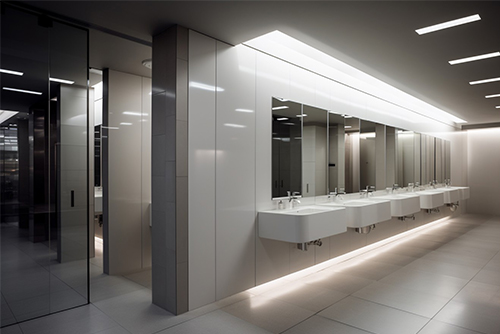
Phenolic partition panels in a commercial restroom
Phenolic toilet partitions are engineered dividers built for high-traffic, moisture-heavy environments such as schools, airports, shopping malls, and offices. Changzhou Huajiale Decorative Materials Co., Ltd. manufactures the Compact Laminate Panel — a prime example of advanced phenolic board technology widely adopted in modern commercial spaces.
Material Composition
The core of phenolic toilet partitions is a compact laminate produced by stacking multiple layers of kraft paper saturated in phenolic resin, topped with decorative paper infused with melamine resin. The entire stack is bonded under high heat and pressure to produce a dense, dimensionally stable panel ranging from 4 mm to 25 mm in thickness.
Manufacturing Process
Kraft paper sheets are saturated in phenolic resin for structural strength.
Decorative paper with melamine resin is applied for surface aesthetics.
All layers are consolidated under heat and pressure into a dense panel.
The cured surface actively repels moisture and bacteria, simplifying cleaning.
The solid build eliminates swelling, warping, or splitting even in continuous wet conditions.
No metal components means no rust risk in humid restroom environments.
A broad palette of colors and textures is available to suit any design brief.
Key Properties
| Property | Description |
|---|---|
| Waterproof & Moisture-Proof | Panels seal out water entirely, even in steam-filled bathrooms. |
| Chemical Resistance | Withstands acids and alkalis — suitable for labs and hospitals. |
| Impact Resistance | Resists dents, scratches, and deliberate vandalism in public spaces. |
| Slip Resistance | Textured surfaces improve grip and safety in wet areas. |
| Fire Safety | Achieves Class A or B fire ratings, slowing flame spread. |
| Easy Maintenance | Hard to stain, fast to wipe down — ideal for busy facilities. |
| Aesthetic Versatility | Dozens of colors, patterns, and finishes for any design context. |
Benefits of Phenolic Toilet Partitions
Durability & Strength
Phenolic toilet partitions are engineered for extreme durability. The layered kraft-and-resin construction produces panels that resist scratches, graffiti, and sustained impact without peeling or delaminating. Depending on the product specification and EN438 standards, phenolic panels may achieve Class B fire performance ratings.
Phenolic partitions outlast solid plastic alternatives in high-traffic environments.
They do not rot, rust, swell, or degrade from water or bad odors.
Graffiti resistance keeps them presentable in even the busiest public spaces.
Low repair frequency means fewer disruptions and lower facility costs over time.
Water & Moisture Resistance
The waterproof solid core makes phenolic partitions the leading choice for locker rooms, shower areas, and commercial restrooms. Unlike metal or standard laminates, panels will not corrode, swell, or rot regardless of continuous moisture exposure. The smooth, non-porous surface actively prevents bacteria and mold growth, keeping restrooms safer and cleaner for all users.
Fire & Impact Resistance
Phenolic toilet partitions achieve Class A or B ratings in fire testing,[3] satisfying strict international building codes. The solid core also makes panels highly resistant to physical impact — they do not dent or crack under normal public use or minor vandalism.
Hygiene & Easy Cleaning
Public restroom hygiene is a constant operational challenge. Phenolic partitions address this directly: their smooth, dense surface leaves no microscopic pores for bacteria or mold to colonize. Routine cleaning requires only a soft cloth and mild detergent — no specialized chemicals or extended labor. The panels also resist odors, keeping restrooms fresh even under heavy daily use.
Design Versatility
Phenolic toilet partitions give architects and interior designers broad creative freedom. Panels are available in solid colors, wood grain, and stone-effect finishes. Color-matched edge banding keeps edges crisp and uniform. Optional extras — including ventilation louvers, glass door lites, decorative engravings, and full-height moldings — allow fully customized stall configurations.
| Feature Type | Description |
|---|---|
| Color & Pattern | Extensive palette of solid colors and decorative patterns for fully custom looks. |
| Finishes | Matte and velvet textures for a refined, contemporary feel. |
| Edge Colors | Color-matched edge banding for a seamless, finished appearance. |
| Additional Features | Louvers, glass door lites, engravings, and moldings expand design options. |
| Colored Core Options | Color-through technology hides minor scratches and maintains a like-new appearance. |
Ready to Specify Phenolic Partitions for Your Project?
Our team provides fast, accurate quotations for projects of any scale — from single restroom upgrades to large commercial or institutional builds. Tell us your requirements and get expert guidance within one business day.
✓ Custom Colors & Sizes
✓ LEED-Compliant Materials
✓ Factory-Direct Pricing
✓ Fast Turnaround
Sustainability of Phenolic Toilet Partitions
Eco-Friendly Production
Changzhou Huajiale Decorative Materials Co., Ltd. integrates environmental responsibility into every stage of manufacturing. Raw materials — including the phenolic resin core and decorative paper — are sourced from suppliers that adhere to sustainable forestry and low-emission production standards. Modern factory equipment minimizes waste streams and enables closed-loop water recycling, reducing the environmental footprint of each panel produced.
Recyclability
Phenolic panels are engineered for longevity, but at end-of-life they can be processed at recycling facilities — diverting material from landfills and enabling reuse in secondary construction applications. This reduces the total resource consumption of any building project that specifies phenolic partitions.
End-of-life panels can be repurposed in other building applications.
Recycling reduces energy consumption and carbon emissions versus landfill disposal.
Lower landfill contribution supports cleaner urban waste management.
Green Building Compliance
Phenolic toilet partitions help projects achieve leading environmental certifications. The Compact Laminate Panel meets criteria for low emissions, durability, and material safety required by major certification bodies:[4]
Manufacturing Capacity & Lead Time
Manufacturing Capacity
Changzhou Huajiale Decorative Materials Co., Ltd. operates a large-scale production facility designed to handle projects of any size — from single restroom upgrades to full institutional builds — with consistent quality and on-schedule delivery.
| Capability | Details |
|---|---|
| Monthly Output | 80,000 m² — suitable for large commercial and institutional projects |
| CNC Machining | Precision cutting, drilling, and profiling to exact customer specifications |
| OEM / ODM | Custom branding, private labeling, and bespoke product development |
| Project Engineering Support | End-to-end assistance: design consultation, technical drawings, and compliance documentation |
Lead Time
Lead times are calculated from order confirmation and vary by color selection and project volume. Rush production may be available upon request — contact the sales team for details.
| Order Type | Estimated Lead Time | Notes |
|---|---|---|
| Standard Colors | 15–20 days | In-stock color options; fastest dispatch |
| Custom Colors | 20–30 days | Bespoke color matching and specialty finishes |
| Large Projects | 30–45 days | High-volume orders; includes quality inspection and palletizing |
Colors and Finishes
Standard Color Options
The standard range includes neutral, bold, and natural-effect tones to suit both classic and contemporary restroom designs:
Almond · Neutral Glace · Desert Zephyr · Tungsten EV · Taupe
Silver Gray · Folkstone Celesta · Dove Gray · Graphite Grafix
Washed Knotty Ash · Burnt Strand · Weathered Ash · Hazel
Burgundy · Smoke · Navy Blue · Fog · Black
Customization Choices
Beyond the standard palette, phenolic toilet partitions support full customization: bespoke brand colors, institutional identity patterns, custom engravings, and logo integration. Color-through technology ensures that even heavily used panels retain their appearance — scratches and chips reveal the same color throughout the panel depth, not a contrasting substrate.
Surface Textures
Available textures include matte, velvet, and realistic wood-grain effects. Each texture choice affects both aesthetics and practical performance: textured surfaces reduce visible fingerprints and provide better slip resistance in wet zones. Color-through panels maintain visual consistency from surface to core, preserving a premium appearance through years of heavy use.
Mounting & Privacy Options
Floor-Mounted Overhead-Braced
The most common configuration for commercial restrooms. Panels anchor directly to the floor with a stabilizing headrail at the top. This approach accommodates most standard concrete and tile subfloors and delivers a clean, contemporary appearance. Hardware options include stainless steel hinges and pilaster shoes, with an anti-grip headrail to prevent misuse.
| Feature | Description |
|---|---|
| Color Options | Full standard and custom color palette |
| Hardware | Stainless steel hinges, pilaster shoes, anti-grip headrail |
| Privacy Features | No-sight doors, full-length hinges, rabbeted edges |
| Panel Properties | Waterproof, impact-resistant, fire-rated |
Ceiling-Hung
Panels suspend from structural ceiling supports, leaving the floor completely open. This dramatically simplifies floor cleaning and creates a modern, floating aesthetic. Ceiling-hung systems require adequate structural support above and are not recommended for stalls narrower than 31 inches or very high-traffic facilities. Additional hardware costs apply.
| Advantages | Limitations |
|---|---|
| Unobstructed floor — easy mopping and cleaning | Requires verified structural ceiling support |
| Clean, minimalist aesthetic | Higher hardware costs than floor-mounted systems |
| Suitable where floor penetrations are undesirable | Not suitable for stalls under 31" wide or very heavy use |
Floor-to-Ceiling
The most structurally stable and acoustically private option. Panels anchor at both floor and ceiling, creating a full enclosure around each stall. Dual anchor points eliminate movement entirely. Ideal for premium facilities, healthcare settings, and any environment where maximum privacy is the primary requirement.
Enhanced Privacy Features
Privacy expectations in public restrooms have risen significantly. Modern phenolic partition systems offer a range of engineered privacy enhancements:
| Feature | Description |
|---|---|
| Increased Door Height | Doors up to 92 inches tall eliminate over-partition sightlines. |
| Overlapping Doors | Door edge extends past the pilaster, sealing the gap completely. |
| No-Sightline Systems | Overlapping doors and pilasters eliminate all gap-related sightlines — ideal for all-gender restrooms. |
| Occupancy Indicator | Color-changing latch signals stall occupancy clearly from outside. |
Phenolic Toilet Compartment Thickness
Standard Thickness Options
| Component | Standard Thickness |
|---|---|
| Panels and Doors | 1/2" (approx. 13 mm) |
| Pilasters | 3/4" (approx. 19 mm) |
Thicker pilasters provide the vertical structural support needed to keep the entire partition system stable, even under repeated lateral force. These dimensions satisfy building codes in most jurisdictions and are compatible with standard ADA-compliant hardware.[6]
Application-Based Selection
High-traffic venues (airports, transit hubs, stadiums) benefit from maximum-thickness panels for added impact resistance and noise reduction.
Lower-traffic environments such as private offices or small clinics can use standard 1/2" panels effectively.
Always verify thickness requirements against local building codes and ADA guidelines before finalizing specifications.
Installation & Maintenance
Preparation Steps
| Step | Action |
|---|---|
| A | Thoroughly clean and dry all mounting surfaces before starting. |
| B | Follow the manufacturer's surface preparation specifications for optimal adhesion and fit. |
Installation Process
Mark panel positions on the floor and walls using a tape measure and spirit level. Secure brackets, then mount pilasters before fitting panels and doors. Use only the manufacturer-supplied fasteners and anchors — substitutions can compromise structural integrity. Test all door movements and adjust hinges before finalizing. Add privacy features (occupancy indicators, no-sight doors) as specified.
Maintenance Schedule
| Task | Frequency | Supplies |
|---|---|---|
| Surface wipe-down | Daily | Mild soap, soft cloth |
| Hardware inspection | Weekly | Screwdriver, lubricant |
| Graffiti & stain check | Weekly | Gentle surface cleaner |
| Full structural inspection | Monthly | Checklist, touch-up kit |
Compare Phenolic to Other Materials
Phenolic vs. HDPE
HDPE (high-density polyethylene) partitions excel at impact resistance and have the lowest 25-year total cost of ownership, making them popular in budget-conscious public projects. However, phenolic panels offer a significantly broader design palette and a more premium visual finish. For projects prioritizing aesthetics alongside durability, phenolic is the stronger choice.[7]
Phenolic vs. Stainless Steel
| Feature | Phenolic | Stainless Steel |
|---|---|---|
| Aesthetic Appeal | Premium look with color integrated throughout | Sleek and modern appearance |
| Durability | High — moisture and vandal resistant | Superior — corrosion resistant |
| Maintenance | Minor scratches less visible | Easy to clean, shows fingerprints |
| Cost | Premium but strong ROI | Higher upfront, excellent longevity |
Phenolic vs. HPL
High-pressure laminate (HPL) panels look similar to phenolic but differ fundamentally in core construction. HPL uses particleboard or MDF as its substrate — materials that can swell, delaminate, or deteriorate with sustained moisture exposure. Phenolic's solid homogeneous core makes it far more suitable for wet or heavily used environments. HPL is an appropriate choice only for low-traffic, dry-area installations.
Pros & Cons Summary
| Material | Pros | Cons |
|---|---|---|
| Phenolic | Extremely strong · Fully waterproof · Fire-rated · Easy to clean · Wide design range · Long service life · Green building compliant | Higher upfront cost · Heavier than alternatives |
| HDPE | Impact resistant · Lower cost · Easy cleaning · Rust-free · Mold/mildew resistant | Limited color range · Surface scratches visible over time |
| Stainless Steel | Very tough · Corrosion resistant · Hygienic · Modern aesthetic | Shows fingerprints · Highest initial cost · Limited color options |
| HPL | Lower cost · Many design options · Lightweight | Not waterproof · Risk of swelling if wet · Shorter lifespan in wet areas |
Get a Custom Quotation for Your Restroom Project
Whether you are designing a new facility or upgrading an existing one, our specialists can match the right phenolic partition system to your technical and aesthetic requirements. Share your project details and receive a tailored proposal.
✓ Residential & Commercial
✓ Institutional & Healthcare
✓ Custom Lead Times
✓ Expert Technical Support
Frequently Asked Questions
What are phenolic toilet partitions?
Phenolic toilet partitions are solid-core bathroom dividers constructed from layers of resin-impregnated paper compressed under high heat and pressure. They are waterproof, impact-resistant, and widely used in schools, airports, malls, and offices.
How long do phenolic toilet partitions last?
With proper maintenance, phenolic toilet partitions typically last 20 years or more. The solid homogeneous core resists water damage and physical impact, maintaining structural integrity through decades of continuous use.
Are phenolic toilet partitions safe in wet environments?
Yes. The solid phenolic core does not absorb water, so panels will not swell, warp, or rot — even in shower areas, locker rooms, or other continuously damp spaces. See our waterproofing guide for detailed technical data.
Can I specify custom colors or finishes?
Yes. In addition to a broad standard palette, custom colors, branded patterns, engraved logos, and specialty textures are all available. Color-through technology ensures any chips or abrasion remain virtually invisible.
What is the recommended cleaning method?
Wipe panels with a soft cloth dampened with mild soap and warm water. Dry with a clean towel to prevent water spots. Avoid abrasive pads, scouring powders, and solvent-based cleaners.
Are phenolic toilet partitions eco-friendly?
Yes. Responsibly sourced raw materials, low-emission production processes, and recyclability at end-of-life contribute to strong environmental performance. Panels can support LEED, BREEAM, and HQE certification credits.
Do phenolic toilet partitions comply with building codes?
Yes. They meet fire safety, hygiene, and ADA accessibility requirements across most international building codes. Always verify compliance with your specific local regulations before finalizing specifications.
References
Mavi New York — Comprehensive Guide to Toilet Partition Materials. Accessed 2026.
AZ Big Media — Choosing Toilet Partitions: Solid Plastic vs. Phenolic Finish. Accessed 2026.
Mavi New York Products — Color-Through Phenolic Toilet Partitions — Fire Rating Details. Accessed 2026.
Market Data Forecast — Global Toilet Partition Market Report — Green Building Compliance. Accessed 2026.
ToiletPartitions.com — How Much Are Toilet Partitions? 2026 Pricing Guide. Accessed 2026.
US Partitions — How Thick Are Different Toilet Partitions? A Material-Wise Guide. Accessed 2026.
Scranton Products — HDPE vs. Phenolic: 25-Year Cost-of-Ownership Comparison. Accessed 2026.
CATEGORIES:

 Contact Us
 Online Sales
 Case Study
 News Center
 Product Brochure


