What Is the Most Durable Material for an Outdoor Dining Table in 2026?

The most expensive part of furnishing a restaurant terrace, a hotel patio, or a garden dining area is usually not the table itself — it is replacing it. An outdoor dining table sits in direct sun, rain, salt air, and the occasional dropped plate, and the material it is made of largely decides whether it lasts five years or twenty. So what is the most durable material for an outdoor dining table in 2026? This guide compares the main options in plain language, with practical details buyers can actually use.
Key Takeaways
There is no single "most durable" material — the right choice depends on climate, how heavily the table is used, and whether it is for a home or a commercial space.
For commercial hospitality use, an exterior-grade HPL tabletop combined with a powder-coated metal base offers one of the best balances of durability, easy cleaning, and low maintenance.
Teak remains the premium wood option, naturally resistant to moisture and insects, but it needs periodic oiling and costs more than most alternatives.
Aluminum is the lightweight, rust-resistant metal choice; powder-coated steel and cast iron are heavier but very sturdy when the coating is maintained.
Real durability depends on the whole table — the top, the frame, the fasteners, and the surface coating — not on any single material alone.
What Makes a Material "Durable" for Outdoor Use?
Durability sounds simple, but it is actually a combination of several properties. A material that is great in the sun can fail in the rain, and one that resists moisture can still fade or crack. When evaluating any outdoor table, the following factors matter most:
UV resistance: How well the surface resists fading and degradation under strong, direct sunlight.
Moisture resistance: How well the table survives rain, humidity, and standing water without warping, swelling, or rotting.
Temperature tolerance: Whether the material can handle freezing winters and intense summer heat without cracking or softening.
Impact and scratch resistance: How the surface copes with dropped plates, moved chairs, and everyday commercial abuse.
Corrosion resistance: For metal parts, how well the frame and fasteners resist rust, especially in coastal or high-humidity areas.
Maintenance: How much cleaning, sealing, or re-coating the table needs to stay in good condition.
The Main Materials Compared
Most commercial and residential outdoor tables are built around one of the materials below. The table shows how they compare in the areas that determine real-world durability.
| Material | Weather Resistance | Maintenance | Best For | Typical Service Life* |
|---|---|---|---|---|
| Exterior-grade HPL | Very high — UV-resistant, low water absorption, stain and scratch resistant | Very low — wipe-clean, no sealing | Restaurants, cafés, hotels, busy patios | 10+ years |
| Teak wood | High — natural oils resist moisture and insects | Medium — periodic oiling recommended | Premium residential and resort settings | 20+ years |
| Aluminum | High — self-forming oxide layer resists rust | Low — occasional cleaning | Lightweight, moveable seating and tables | 10–20 years |
| Powder-coated steel / cast iron | High when coated — coating resists corrosion | Low to medium — touch up chips | Heavy-duty commercial bases and frames | 10–15 years |
| Resin wicker (PE rattan) | High — UV-stabilized, weatherproof | Low — hose down | Leisure and poolside settings | 5–10 years |
| Concrete / stone | Very high — nearly weatherproof | Very low — but heavy and may crack | Permanent installations | 20+ years |
*Typical service life under normal outdoor exposure with reasonable care; actual results vary by climate and build quality.
Exterior-Grade HPL — the Low-Maintenance Commercial Favorite
HPL, or high-pressure laminate, has become one of the most popular tabletop materials for commercial outdoor dining, and for a clear technical reason. HPL is made by layering kraft paper impregnated with thermosetting resin, topped with a decorative surface layer, and fusing everything under high heat and high pressure. Exterior-grade HPL is formulated specifically for outdoor exposure, with a UV-resistant surface that holds its color far better than standard indoor laminate.
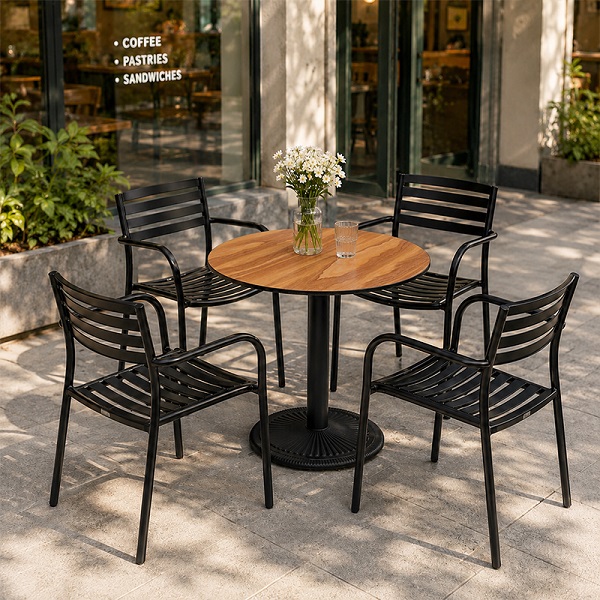
For tabletops, exterior-grade HPL is typically supplied in thicknesses from about 6 mm to 18 mm, with 12 mm a common commercial choice because it is rigid enough to span a table base without flexing. For projects that need an even thicker, more rigid surface, compact laminate panels are a related high-pressure material available in heavier formats. The surface resists scratches, stains, heat, and impact, and — critically for hospitality — it can be wiped down and disinfected easily, which matters in food-contact areas. Because the material has very low water absorption, it does not warp, swell, or split the way solid wood can. With normal care, a quality HPL top is expected to give a decade or more of outdoor service.
Teak and Other Hardwoods
Teak is often described as the king of outdoor woods, and the reputation is partly earned. Teak contains natural oils that make it highly resistant to moisture, rot, and insect attack, which is why a well-made teak table can last for decades. The trade-offs are cost and maintenance. Teak is one of the more expensive furniture woods, and it gradually turns silver-gray unless it is oiled periodically. For buyers who value natural grain and do not mind routine care, teak remains a very durable option. Buyers sourcing hardwood furniture may also want to check that the wood comes from responsibly managed sources; the Forest Stewardship Council provides certification for sustainably sourced timber.
Aluminum, Steel, and Cast Iron — the Metals That Hold the Table Up
Metal plays two roles in an outdoor dining table: it can form the frame and base, or the entire tabletop. Aluminum is popular because it is lightweight and naturally rust-resistant — the metal forms a thin, self-repairing oxide layer when exposed to air. Powder-coated steel and cast iron are heavier and extremely sturdy, which makes them a common choice for pedestal bases on commercial tables. Cast iron in particular provides excellent stability, so a table stays put in wind and heavy use.
The durability of any metal part depends heavily on its protective coating. Powder coating — a dry powder applied electrostatically and then cured in an oven — produces a tougher, more weather-resistant finish than conventional liquid paint, which is why it is the standard for outdoor furniture. The Powder Coating Institute publishes detailed background on why powder coating outperforms paint for exterior metalwork. Where rust protection is a priority, corrosion-control methods such as hot-dip galvanizing are also widely used and well documented by the American Galvanizers Association. The practical rule for buyers is simple: check that the frame and base are coated, and understand that a small chip in the coating should be touched up promptly to prevent rust from spreading underneath.
Resin Wicker, Recycled Plastic, and Concrete
Resin wicker, also called PE rattan, is a synthetic weave wrapped around a frame. It is UV-stabilized and weatherproof, so it fades slowly and can simply be hosed down. The weakness is usually the frame — a steel frame can rust if its coating is damaged — so quality depends on what is underneath the weave. Recycled plastic and wood-plastic composites are extremely low-maintenance and resist moisture and insects, though they can fade over many years and generally offer a more casual look. Concrete and stone are among the most weatherproof materials available, with very long service lives, but they are heavy, expensive to move, and can crack or etch over time.
The Base and Frame Matter as Much as the Top
Many buyers focus only on the tabletop and overlook the structure underneath, but a beautiful top on a weak base is not a durable table. The base carries the load, resists wind, and keeps the table level on uneven ground. A heavy, well-balanced pedestal base is a strong indicator of longevity in commercial settings. It is also worth checking the fasteners and joints, because corrosion usually starts where two metal parts meet, not in the middle of a clean surface.
What Commercial and Hospitality Buyers Should Look For
Demand for durable outdoor dining furniture is growing. According to a market report from Grand View Research, the global outdoor furniture market was estimated at USD 53.3 billion in 2025, is projected to reach about USD 56.1 billion in 2026 and USD 86.6 billion by 2033, with a compound annual growth rate of 6.4% from 2026 to 2033. The same report notes that restaurants, cafés, and hotels are investing heavily in outdoor dining infrastructure, which is pushing buyers toward commercial-grade products that can handle daily use in all weather.
For a commercial outdoor table, the purchasing priority is usually straightforward: lowest lifetime cost, not lowest purchase price. That means a surface that resists stains and scratches, cleans quickly, and will not need to be replaced every few years. This is why exterior-grade HPL tops on powder-coated cast iron or steel bases have become a standard specification for hospitality projects. Buyers evaluating their options can browse the manufacturer's full product range and review real-world hospitality case studies to see how these materials perform in service.
How to Choose the Most Durable Outdoor Dining Table
Before placing an order, buyers can work through a short checklist to avoid the most common mistakes:
Match the material to the climate: Coastal and high-humidity locations demand better corrosion protection; strong-sun regions demand better UV resistance.
Decide who will use it: Commercial tables take far more abuse than residential ones, so the specification should be heavier-duty.
Check the whole table, not just the top: Ask about the base material, the coating system, and the fasteners.
Confirm size and custom needs: For projects, OEM and custom sizes avoid a table that is too small for the space or the market.
Ask about real-world testing: Reliable suppliers can explain how their materials perform in sun, rain, and salt exposure.
For project sizes, OEM requirements, and custom colors, buyers can send an inquiry directly to the manufacturer and receive a specification-based recommendation.
Conclusion
There is no single material that is "the most durable" for every outdoor dining table, because durability is a balance of UV resistance, moisture resistance, impact resistance, corrosion protection, and maintenance. For busy commercial environments, exterior-grade HPL tops on powder-coated metal bases consistently deliver the best combination of long service life and low upkeep. For premium residential use, teak offers timeless appeal with more care, while aluminum provides a lightweight, rust-resistant alternative. Whatever the choice, the smartest approach is to evaluate the table as a whole — top, base, coating, and fasteners — rather than any single component.
Frequently Asked Questions
For commercial use, exterior-grade HPL tabletops on powder-coated metal bases offer the best balance of weather resistance, easy cleaning, and low maintenance. Teak is the most durable premium wood, and concrete or stone are extremely durable for permanent installations.
Yes, but only exterior-grade HPL. It has a UV-resistant surface, very low water absorption, and resists scratches and stains, so it holds its appearance outdoors without sealing or painting.
With reasonable care, a well-made teak table can last 20 years or more. Periodic oiling is recommended to slow the natural silver-gray patina.
Powder coating resists corrosion very well, but it is not indestructible. If the coating is chipped, the exposed metal can rust, so chips should be touched up promptly, especially on steel or cast iron.
Most hospitality projects choose exterior-grade HPL tops on powder-coated cast iron or steel bases, because the surface cleans easily and the whole table stands up to daily commercial use in all weather.
It depends on the material. HPL, aluminum, resin wicker, and concrete need little more than cleaning. Teak needs periodic oiling, and painted or coated metal benefits from prompt touch-up of any chips.
Looking for a Reliable Outdoor Dining Table Manufacturer?
HUAJIALE manufactures commercial outdoor tables with 12mm exterior-grade HPL tabletops and heavy-duty powder-coated cast iron pedestal bases — built for restaurants, cafés, hotels, patios, and garden dining. Multiple colors, sizes, and base styles are available, with OEM and custom options for project orders. Factory-direct support and worldwide delivery make it easier to start or scale your outdoor dining program.
Get a Free Quote from HUAJIALEView HUAJIALE Products →Tags:
CATEGORIES:

 Contact Us
 Online Sales
 Case Study
 News Center
 Product Brochure