How to Choose Phenolic Toilet Partitions for Schools and Universities

School and university restrooms face a unique set of demands: constant heavy use, moisture, the need for easy cleaning, and the expectation that facilities will stay presentable for years with minimal intervention. Choosing the right partition material is one of the most consequential decisions in any restroom refurbishment. This guide explains what phenolic compact laminate panels are, what actually matters when selecting them for educational settings, and how to evaluate suppliers based on verifiable capabilities.
Key Takeaways
Compact laminate panel (phenolic board) is a solid-core panel with no MDF or particleboard substrate — it cannot swell, delaminate, or harbor moisture, making it reliable in high-humidity school restrooms.
Huajiale's panels meet EN 438 and GB/T 7911 quality standards, and carry an EN 13501 fire rating of B-s2,d0 (B1 fire prevention grade).
Panel density of 1,450–1,500 kg/m³ provides structural rigidity for floor-mounted, overhead-braced, and full-height partition systems without additional framing.
Over 3,000 color and texture options are available, including solid colors, wood grain, stone grain, and decorative patterns — both panel faces carry the same decorative finish.
Standard sheet sizes are 1,200 × 2,400 mm and 1,200 × 3,000 mm; custom sizes, CNC-fabricated components, and OEM/ODM orders are all supported.
Lead times: 15–20 days for standard colors, 20–30 days for custom colors, 30–45 days for large institutional projects.
Routine maintenance requires only mild soap and water — no specialist cleaning products are needed.
What Is Compact Laminate Board(Phenolic Board)?
Compact laminate board — often called phenolic board in the partition industry — is a solid-core structural panel manufactured by layering multiple sheets of kraft paper saturated with phenolic resin, then bonding them under high temperature and high pressure. Unlike standard HPL (which bonds a thin decorative layer onto a substrate), compact laminate panel is solid through its entire thickness. There is no particleboard or MDF core that can swell, delaminate, or harbor moisture.
The production process produces a panel with a density of approximately 1,450–1,500 kg/m³, giving it the structural rigidity needed for floor-to-ceiling or floor-mounted partition systems without additional framing. Both faces carry the same decorative surface, so the panel looks consistent from any angle and cut edges can be left visible or finished as needed.
Huajiale's compact laminate panels are manufactured to EN 438 quality standards and achieve an EN 13501 fire classification of B-s2,d0 — meaning limited combustibility, very limited smoke production, and no burning droplets. The panels also comply with GB/T 7911, the Chinese national standard for thermosetting resin decorative laminates.
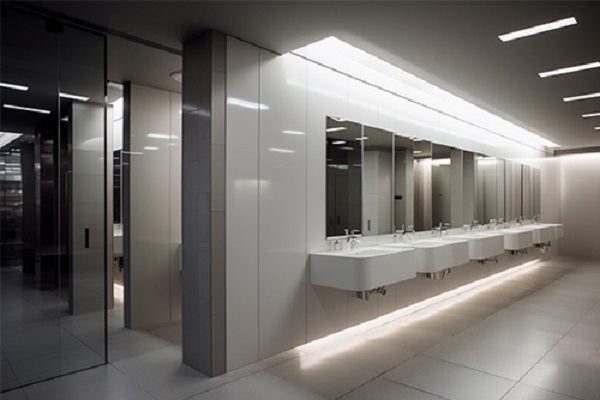
Why Compact Laminate panel Suits Educational Restrooms
Moisture and Humidity Resistance
School restrooms are wet environments. Water from hand-washing, cleaning, and condensation is a daily reality. Compact laminate panel's solid phenolic core does not absorb moisture in the way that particleboard or MDF-cored panels do, which prevents the swelling, warping, and mold growth that shorten the lifespan of lesser materials. This makes it a practical choice for standard restrooms as well as shower rooms and changing areas in sports facilities.
Impact and Surface Durability
High-traffic environments generate a lot of incidental contact — doors swinging, bags catching edges, general wear from thousands of users over a year. Compact laminate panel's dense structure provides strong resistance to everyday wear and surface damage in high-traffic environments in comparable thicknesses. The decorative layer is integral to the panel rather than a coating that can chip or peel.
Cleanability and Hygiene
The surface of compact laminate panels is non-porous, which means the non-porous surface can be cleaned easily as part of routine maintenance. Routine cleaning with mild soap and water is sufficient for daily maintenance. For stubborn staining, a diluted household cleaner or acetone can be used on a small area first. Custodial staff can clean these surfaces quickly and thoroughly without specialist products.
Fire Performance
Educational buildings are subject to fire safety requirements that vary by jurisdiction, but in most markets the expectation is that interior fit-out materials perform to a minimum fire class. Huajiale's compact laminate panel achieves EN 13501 classification B-s2,d0: the panel will not readily ignite, produces limited smoke, and does not release burning droplets. Specifiers working to European standards, or international projects requiring EN compliance.
Design Flexibility
Schools often want restrooms that feel designed rather than purely functional. Compact laminate panel is available in over 3,000 colors and surface textures — including solid colors, wood grain, stone grain, and a range of decorative patterns such as linen cloth, micro-mosaic, and geometric emboss. Both faces of the panel carry the decorative finish, so visible edges and cut profiles are consistent with the face surface. This allows architects and interior designers to specify a look that integrates with corridor and classroom finishes rather than treating the restroom as an afterthought.
Key Selection Criteria for School Projects
Panel Thickness and Structural Adequacy
Partition panels need to span between floor and ceiling (or floor and overhead rail) without excessive flex. For most restroom cubicle applications, panels in the 10–13 mm range are standard. Huajiale produces panels from 4.5 mm to 8.5 mm as standard, with custom thicknesses available for specific structural requirements. Confirm the required thickness with your partition system supplier or fabricator before ordering.
Fire Classification Requirements
Check the applicable building code or specification for the project. If EN 13501 compliance is required, confirm the specific class (B, C, D) and any sub-ratings for smoke (s1, s2, s3) and droplets (d0, d1, d2). Huajiale's standard compact laminate panel achieves B-s2,d0.
Color and Texture Continuity
For multi-building or phased campus projects, it is worth confirming with the manufacturer how color consistency is managed across production batches. Huajiale's standard color library covers 3,000+ options; custom colors can be developed for large-volume projects with a lead time of 20–30 days. Ordering panels for the same project from a single production run is the most reliable way to ensure consistency.
Sheet Size and Waste Optimization
Standard sheet sizes from Huajiale are 1,200 × 2,400 mm and 1,200 × 3,000 mm, with custom sizes available on request. When planning a partition installation, optimize the cutting layout against the sheet size to minimize offcut waste. Fabricators with CNC capability — which Huajiale's factory supports — can produce precision-cut components directly from your partition drawings, reducing site labour and improving fit.
Lead Time Planning
For school projects, construction programs are often tight and restroom fit-out typically falls at the end of the schedule. Plan material procurement accordingly:
Standard colors: 15–20 days from confirmed order
Custom colors: 20–30 days
Large institutional projects: 30–45 days
Engage Huajiale early in the project to lock in lead times and avoid delays.
Compact Laminate panel vs. Alternative Partition Materials
Compact laminate panel is not the only option for school restroom partitions, but it is worth understanding why it is often selected over alternatives in institutional settings.
| Material | Key Strengths | Limitations in Educational Settings |
|---|---|---|
| Compact Laminate panel (Phenolic) | Solid core, no substrate to swell; excellent moisture and impact resistance; wide color range; easily cleaned | Higher unit cost than powder-coated steel; requires fabrication with appropriate tooling |
| Powder-Coated Steel | Lower upfront cost; widely available | Prone to surface chipping and rust in humid environments; limited lifespan in wet areas |
| Solid Plastic (HDPE) | Very good moisture resistance; graffiti-resistant | Limited color and texture options; less rigid in thinner profiles; less premium appearance |
| MDF-Core HPL | Lower cost; wide color range | MDF substrate vulnerable to moisture; not suitable for high-humidity or wet area applications |
For schools with high occupancy, frequent cleaning schedules, and moisture exposure, compact laminate panel is often selected for projects requiring a balance of durability, maintenance efficiency, and design flexibility. For lower-traffic secondary spaces or budget-constrained projects, powder-coated steel or solid plastic may be appropriate — but neither will match compact laminate's performance in a busy main-block restroom.
Installation and Layout Considerations
Partition System Configuration
Compact laminate panels are used in several partition system configurations depending on the required height, privacy level, and structural approach:
Floor-mounted, overhead-braced: The most common configuration for standard restrooms. Panels rest on feet and are braced at the top by a continuous rail, providing stability without floor-to-ceiling height.
Floor-to-ceiling (full height): Provides maximum visual privacy and is often specified for gender-neutral restrooms or facilities where enhanced privacy is a design requirement.
Ceiling-hung: No floor-level obstructions, making cleaning easier; requires structural support from above.
The panel system type affects the hardware specification, the structural fixing approach, and the level of site installation skill required. Confirm the system type before ordering panels, as different configurations may call for different panel thicknesses or edge treatments.
Accessibility Requirements
Accessible (ambulant or wheelchair-accessible) cubicles have specific dimensional and hardware requirements under local building regulations and accessibility standards. Requirements typically include minimum internal cubicle dimensions, outward-opening or sliding doors, horizontal grab rails, and hardware operable without tight gripping or twisting. Compact laminate panels can be cut and fabricated to any required dimension, and accessible-compliant hardware is widely available for use with compact laminate systems. Confirm the applicable standard for your jurisdiction before finalizing layouts.
Hygiene Detailing
In high-use school restrooms, the detail at panel joints, floor lines, and door frames matters for long-term hygiene. Minimize horizontal ledges where moisture and debris can accumulate. Choose stainless steel or zinc alloy hardware rather than aluminum or painted steel, which are more susceptible to corrosion from cleaning chemicals. Where floor-mounted systems are used, ensure feet are adjustable for level installation and that the gap between the foot and floor can be sealed or cleaned easily.
About Huajiale's Manufacturing Capability
Changzhou Huajiale Decorative Materials Co., Ltd. is a compact laminate panel and HPL manufacturer based in Changzhou, Jiangsu, China. The company produces high-pressure decorative laminates for partition, wall cladding, locker, and furniture applications, supplying projects in educational, medical, hospitality, and commercial sectors.
| Capability | Detail |
|---|---|
| Monthly Output | 80,000 m² |
| Standard Sheet Sizes | 1,200 × 2,400 mm / 1,200 × 3,000 mm (custom available) |
| Panel Thickness | 4.5–8.5 mm standard; custom on request |
| Color Options | 3,000+ (solid, wood grain, stone grain, decorative patterns) |
| Surface Textures | Matt, gloss, micro-dot, linen, wave, emboss, and others |
| Quality Standards | EN 438, GB/T 7911 |
| Fire Rating | EN 13501 B-s2,d0; B1 fire prevention grade |
| Density | 1,450–1,500 kg/m³ |
| CNC Machining | Available for precision fabrication to drawing |
| OEM/ODM | Supported |
| Lead Time — Standard Colors | 15–20 days |
| Lead Time — Custom Colors | 20–30 days |
| Lead Time — Large Projects | 30–45 days |
Huajiale's product range also includes non-combustible laminate, fiberglass laminate, chemical-resistant laminate (physicochemical board), and refractory laminate. For educational projects with laboratory or specialist spaces, these products may be relevant alongside standard compact laminate panel for restroom partitions.
To discuss a specific project, request samples, or obtain a quotation, contact Huajiale via the inquiry page or by email at support@czhjl.com.cn.
Get a Quote for Your School or University Project
Tell us your panel dimensions, quantities, color preferences, and project timeline — our team will respond with pricing and lead time within one business day.
Frequently Asked Questions
- What is a phenolic (compact laminate panel) toilet partition?
- Phenolic toilet partitions are made from compact laminate panel — multiple layers of kraft paper impregnated with phenolic resin, fused under high temperature and pressure. The result is a dense, solid-core panel that resists moisture, impact, and surface damage, making it well-suited to high-traffic restrooms in schools and universities.
- What thickness is commonly used for toilet partition panels?
- For toilet partitions and cubicles, compact laminate panels in the 10–13 mm range are typical. Huajiale produces standard thicknesses from 4.5 mm to 8.5 mm and can supply custom thicknesses depending on the partition system and structural requirements.
- Does compact laminate panel have fire-performance test reports?
- Huajiale's compact laminate panels carry an EN 13501 fire classification of B-s2,d0 and meet B1 fire prevention grade. Panels also comply with EN 438 and GB/T 7911. Project-specific test documentation can be requested at inquiry stage.
- How many color options are available?
- Huajiale offers more than 3,000 color and surface texture options, including solid colors, wood grain, stone grain, and a range of decorative patterns. Custom colors can be developed for projects with sufficient volume, with a lead time of 20–30 days.
- What is the typical lead time for a school project?
- Standard color orders: 15–20 days. Custom colors: 20–30 days. Large institutional projects: 30–45 days. Additional shipping and customs time should be factored in for international orders.
- Can Huajiale supply OEM or custom-sized panels?
- Yes. Huajiale supports OEM and ODM orders and can produce panels to custom sizes. Standard sheet sizes are 1,200 × 2,400 mm and 1,200 × 3,000 mm. CNC machining is available for precision-fabricated components.
Tags:
CATEGORIES:

 Contact Us
 Online Sales
 Case Study
 News Center
 Product Brochure