EN 438 Outdoor HPL Durability Explained for Severe Climates

When a building skin must perform through scorching summers, drenching monsoons, and freeze-thaw cycles all within a single service life, the material specification behind it matters as much as the aesthetic. EN 438 outdoor HPL durability is the framework that separates panels engineered for genuine exposure from those that only look the part on a product sheet.
The standard works in two layers. EN 438-6 defines the exterior compact laminate panel grades and sets the minimum performance levels a product must reach to qualify for outdoor use. EN 438-2 supplies the test methods that generate the actual performance data — specific procedures, apparatus requirements, and pass/fail thresholds that appear in accredited lab reports. Together they give specifiers a language for comparing panels objectively and a checklist for verifying that supplier claims hold up to scrutiny.
This guide walks through each layer in sequence: which EN 438-6 grade fits which climate and service-life expectation, what the critical EN 438-2 tests measure and what results to look for, how dimensional stability and surface integrity are evaluated, and how to read a test report so you can separate a properly substantiated claim from a vague grade declaration.
Key Takeaway
Specifying exterior HPL for severe climates starts with two documents — EN 438-6 (grade selection) and EN 438-2 (test evidence). Understanding both lets procurement and design teams compare materials on measurable terms, not marketing claims.
EN 438-6 Exterior Grades
Scope and Thickness ≥ 2 mm
EN 438-6 covers exterior-grade compact laminates with a thickness of 2 mm and greater made by a high-pressure process. The 2 mm floor exists because thinner sheets lack the structural stiffness needed to withstand wind load, panel-level bowing, and fastening stresses in facade service. In most ventilated facade applications the working range runs from 6 mm to 13 mm, with heavier thicknesses favored for larger panel formats or high-wind-zone installations.
The standard is published in its current edition as EN 438-6:2016[1], which remains the active reference for grade classification and minimum property requirements. Any test report citing an earlier edition should be treated as potentially non-current, especially for weathering and climatic shock thresholds that were tightened in later revisions.
Moderate vs Severe Exposure: EGS/EGF and EDS/EDF
EN 438-6 uses a three-letter grade code that encodes exposure level and fire behavior in a readable format:
| Letter | Position | Meaning |
|---|---|---|
| E | 1st | Exterior — outdoor weather exposure |
| G | 2nd | Moderate (General) exposure |
| D | 2nd | Demanding (severe) exposure |
| S | 3rd | Standard grade |
| F | 3rd | Flame-retardant grade |
This produces four working grade designations:
EGS — exterior, moderate exposure, standard
EGF — exterior, moderate exposure, flame-retardant
EDS — exterior, severe exposure, standard
EDF — exterior, severe exposure, flame-retardant
As the European HPL industry technical guide on exterior applications[2] notes, EGS/EGF panels are generally produced in lighter color ranges and are adequate for sheltered facades or moderate continental climates. For colorful or dark surfaces in high solar-radiation zones, EDS/EDF grades with enhanced UV and weathering protection are the correct specification.
Selecting Grades by Climate and Service Life
Grade selection should account for three variables: radiation intensity, temperature swing amplitude, and moisture cycling frequency.
Tropical coastal climates combine all three stressors — intense UV, high humidity, and salt-laden air. Subarctic or high-altitude climates add freeze-thaw cycling to the UV burden. Neither environment is served well by EGS/EGF panels that meet only moderate-exposure thresholds.
A practical decision rule: if the installation sits in a climate with more than 160 sunny days per year, a diurnal temperature swing exceeding 20 °C, or annual rainfall above 1,200 mm, specify EDS/EDF as a baseline. For flame-retardant requirements — increasingly standard in public-building codes — move to EDF.
The grade declaration on a product datasheet is only as reliable as the test report behind it. Confirming grade through accredited EN 438-2 data is the verification step covered later in this article.
Durability Tests in EN 438-2
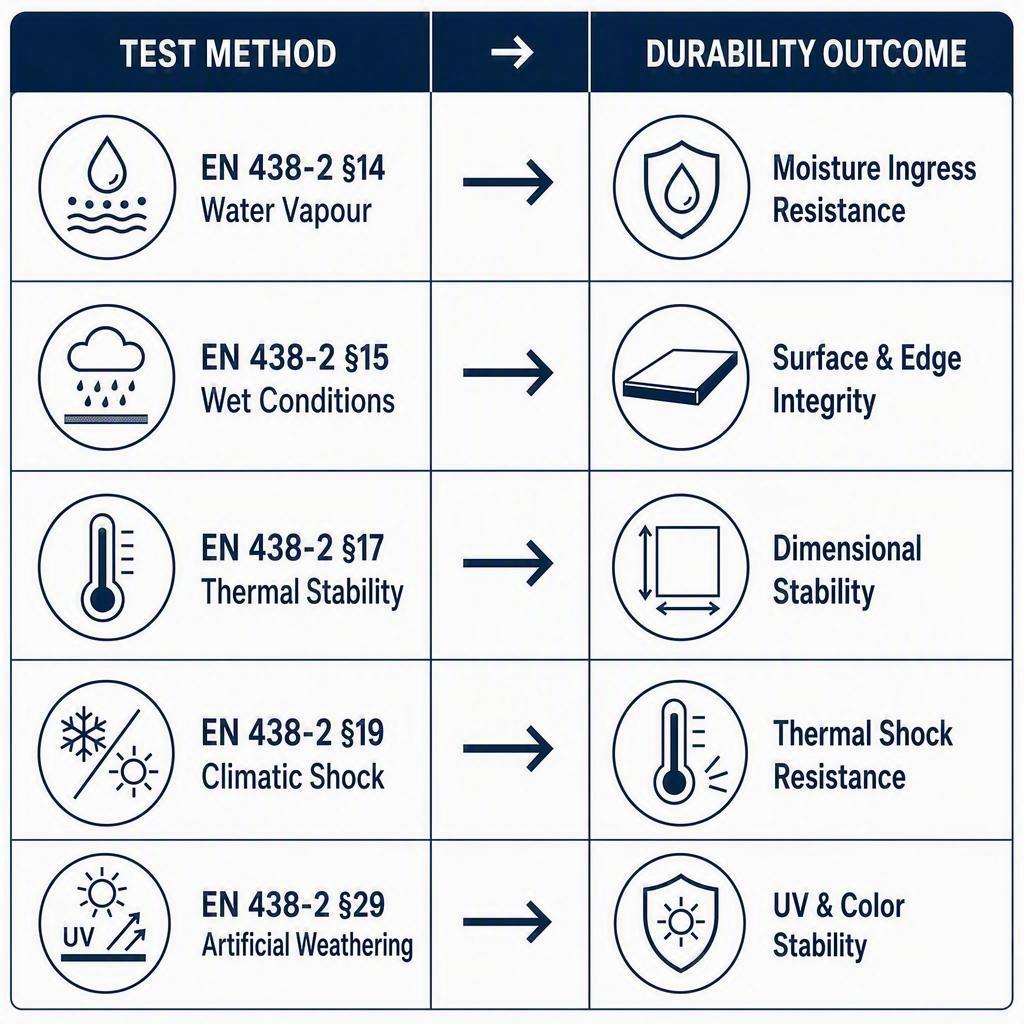
EN 438-2 is the test-methods companion to the grade standard. Its structure for exterior-grade laminates centers on five sections that address the failure modes most relevant to severe climate service.
Artificial Weathering and Lightfastness
EN 438-2 §29 (Resistance to artificial weathering for exterior-grade laminates) uses a xenon-arc lamp to simulate the UV spectrum of solar radiation while cycling temperature and humidity to reproduce condensation and drying sequences. Test parameters typically set a black-standard temperature of 65 ± 3 °C, irradiation intensity of 60 ± 3 W/m², and a 102-minute cycle with 18 minutes of water spray. A representative test run covers 3,009 hours to deliver an exposure dose of 650 MJ/m².
After exposure, panels are assessed on the ISO greyscale:
Grade 5 — no perceptible color change
Grade 4 — slight color change
Grade 3 — noticeable color change (minimum acceptable for most specifications)
Below 3 — unacceptable for facade-grade performance
Published test data for EDS/EDF products typically return greyscale values of 4 to 5 after the full exposure program. EGS/EGF products may be specified to a lower exposure total, so always confirm the total dose (MJ/m²) alongside the greyscale result.
Lightfastness measured per EN ISO 4892-2 adds a separate blue-wool reference scale assessment. Industry-standard specification floors for exterior laminates typically require blue-wool lightfastness of grade 6 or better.
Resistance to Wet Conditions
EN 438-2 §15 evaluates moisture resistance specifically for exterior-grade laminates. Specimens are exposed to water immersion or cycling humidity conditions, then assessed for:
Mass variation (%) — the measured change is compared against the threshold applicable to the declared grade
Surface appearance grade — assessed visually after exposure; a minimum of grade 4 (slight or no defect) is typically required
Edge grade — edges often show higher moisture uptake than face surfaces; grade 4 or higher is expected for properly treated edges
Panels that pass §15 have demonstrated that their core resin system and decorative layer can resist the moisture cycling that causes delamination, blister formation, and adhesion failure in the field.
EN 438-2 §14 (Resistance to water vapor) is a related test evaluating transmission of water vapor through the panel. It is relevant for understanding long-term moisture equilibration in high-humidity climates rather than acute water exposure.
Climatic Thermal Shock Performance
EN 438-2 §19 (Resistance to climatic shock) subjects specimens to rapid transitions between extreme temperature and humidity conditions — simulating the shock experienced when a sun-heated facade panel suddenly encounters a cold rain event. After cycling, specimens are visually inspected for cracking, delamination, or surface crazing, and their key mechanical properties are re-measured to detect any degradation.
Pass criteria require no visible defects and no significant loss of properties compared to unexposed control specimens. This test distinguishes panels with robust resin-to-decor bonding from those that may look durable in catalog photography but fail at laminate layer interfaces when real thermal shocks occur.
Dimensional Stability and Surface Integrity
High-Temperature Dimensional Stability
EN 438-2 §17 measures how much a panel expands or contracts under elevated temperature conditions. Typical reported values for exterior compact laminates fall in the range of 0.4% change or less in each principal direction — that is, no more than 4 mm of movement over 1,000 mm of panel length.
This number is the starting point for joint and fastening design. A 2,400 mm panel of a product with 0.4% movement allowance can be expected to move up to 9.6 mm over its length under extreme temperature swings. Fastening systems and joint widths must accommodate this envelope.
Impact, Scratch, and Stain Resistance
Facade HPL faces mechanical stress from hail, wind-borne debris, and maintenance equipment. EN 438-2 provides methods for:
§20 — Resistance to impact by small-diameter ball (surface indentation)
§10 — Resistance to surface wear (for abrasion-class panels)
§22 — Resistance to staining
For exterior applications, stain resistance is relevant to long-term appearance maintenance: panels exposed to organic residue, industrial fallout, or bird fouling need surfaces that allow cleaning without surface damage. Panels meeting EN 438-2 §22 requirements at grade 5 can be restored to original appearance with standard cleaning agents.
Color and Texture Stability Over Time
Color stability under UV and thermal cycling is the area where the gap between EGS/EGF and EDS/EDF grades is most visible. EDS/EDF panels incorporate UV-stable decorative papers and resin systems engineered to preserve lightness, hue, and chroma across an extended service life.
Beyond color, texture stability matters for surfaces specified in fine-grain, matte, or structured finishes. EN 438-2 §29 reports should include texture assessment — confirming that the surface microtexture resists smoothing or chalking under the artificial weathering program. A panel that retains greyscale 4 color performance but has lost its original finish texture has still suffered a functional failure for appearance-critical facades.
How to Read an EN 438 Test Report
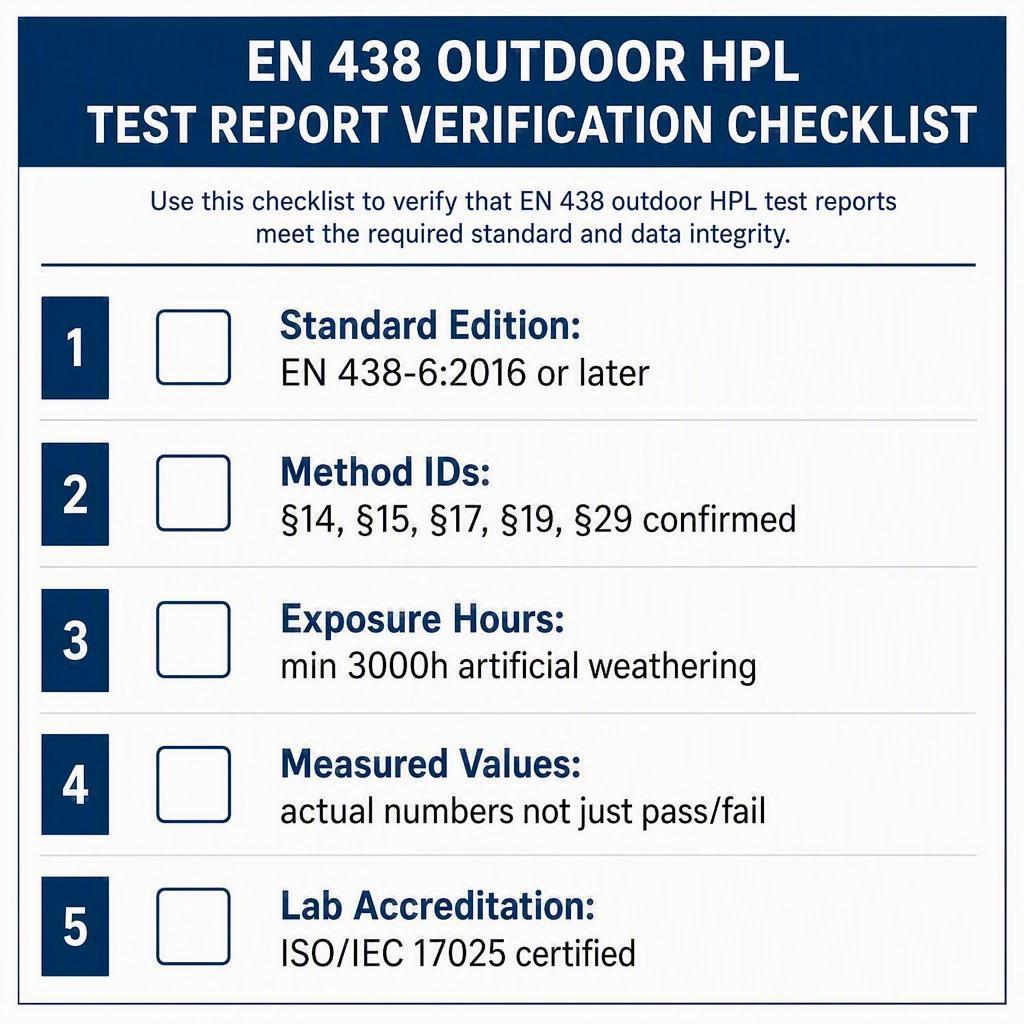
A test report is only as useful as your ability to interpret it. Procurement teams evaluating competing products need to compare equivalent data — and that requires knowing what a complete, trustworthy report looks like.
Edition and Method Identification
Every valid report must state both the standard edition (e.g., EN 438-2:2016[3] or EN 438-2:2016+A1:2018) and the specific section number being tested (§14, §15, §17, §19, §29). Without the edition, you cannot confirm whether the test conditions match current grade requirements. Without the section number, a vague reference to "EN 438-2 weathering" could mean almost anything.
The current active test standard is EN 438-2:2016, with Amendment A1:2018. Reports citing EN 438-2:2005 or earlier are based on superseded editions and may not reflect the tighter thresholds introduced in 2016.
Measured Values vs Pass/Fail Claims
A supplier claiming their product "meets EDS/EDF grade" should be able to provide a report showing actual measured values alongside the required thresholds, not just a pass/fail checkbox. Evaluated data might look like this:
| Test | Section | Measured Value | Required Threshold | Result |
|---|---|---|---|---|
| Artificial weathering | §29 | Greyscale 4 | ≥ 3 | PASS |
| Wet conditions — mass change | §15 | 38% | ≤ 50% | PASS |
| Wet conditions — surface grade | §15 | Grade 4 | ≥ 4 | PASS |
| Dimensional stability (dir. 1) | §17 | 0.35% | ≤ 0.40% | PASS |
| Climatic shock | §19 | No defects | No visible defects | PASS |
Illustrative example only — actual values and thresholds come from the accredited test report for the specific product and declared grade.
If a supplier provides only a pass/fail summary with no underlying numbers, request the full test report. Measured values let you compare two EDS-grade products on how far each sits from the threshold — a product measuring greyscale 5 after 650 MJ/m² is demonstrably more UV-resistant than one measuring greyscale 3, even though both technically pass.
Lab Accreditation and Traceability
Trustworthy reports come from testing laboratories holding ISO/IEC 17025 accreditation[4] from a recognized national accreditation body. The report should identify the lab by name and accreditation number, specify the accreditation scope that covers EN 438-2 testing, and include the test date and sample identification traceable to the product lot.
When evaluating suppliers for exterior facade projects, responsible manufacturers proactively provide accredited test documentation alongside their product specifications. Changzhou Huajiale Decorative Materials, a compact laminate manufacturer with experience supplying panels for infrastructure and commercial projects, documents its product certifications — including fire-resistance classifications and surface-property evidence — as part of its standard technical package. When reviewing any exterior HPL supplier's test portfolio, request the specific report pages showing EN 438-2 §15, §17, §19, and §29 results, confirm the laboratory's accreditation status independently, and verify that the tested product specification (thickness, surface type, and grade declaration) matches the product being supplied. This discipline applies uniformly across suppliers, regardless of brand reputation.
Application Guidance for Severe Climates
Ventilated Facade and Fastening Practices
The majority of EN 438 outdoor HPL durability failures in the field trace back not to the panel itself but to the installation system. Exterior compact laminates perform correctly when installed as a ventilated rainscreen, with a drained and ventilated rear cavity that keeps the back face of the panel dry and temperature-equilibrated.
Key installation requirements:
Maintain a minimum 20 mm free rear cavity at both the base and head of the panel field to allow continuous airflow
Use a corrosion-resistant substructure (aluminum or hot-dip galvanized steel) compatible with the expected exposure category
Specify fixings that permit thermal movement — oversized holes, slotted channels, or sliding clips — rather than restraining the panel rigidly in place
Maintain consistent cavity depth across the facade to prevent stagnant zones that accumulate moisture
Restrained panels in high-temperature swings will develop internal stress. Over time that stress manifests as bowing, cracking at fastening points, or joint closure that damages panel edges.
Dark Colors, Heat Gain, and Movement Allowances
Dark-colored HPL panels absorb more solar radiation and reach significantly higher surface temperatures than light-colored equivalents — sometimes 20 °C to 30 °C hotter at peak conditions. Higher temperatures mean greater thermal expansion, so darker materials require proportionally larger movement allowances in joint and fastening design.
Practical implications for specifiers working with dark HPL in severe climates:
Expand joint widths — minimum 8–10 mm for dark panels in high-solar-radiation zones versus the 6 mm commonly used for light colors
Reduce maximum panel dimensions — shorter panels accumulate less total movement over their length
Select EDS/EDF grades — the enhanced UV stability of severe-exposure grades also contributes to better color and dimensional stability in high-heat conditions
Verify §17 dimensional stability data for the specific color family, not just the product line; colorant systems can influence thermal expansion coefficients
Edge Treatment and System Compatibility
Cut edges of exterior HPL are the most vulnerable point for moisture ingress. Factory edges are typically sealed during panel production, but site-cut edges must be treated on the project. Sealing with a compatible edge sealant or covering with a co-extruded aluminum edge profile prevents capillary moisture uptake into the laminate core.
System compatibility checks should confirm that:
The fastening system has been designed for the specific panel thickness and declared EN 438-6 grade
Sealants and setting blocks are chemically compatible with the HPL resin system
Any thermal bridge through the substructure is addressed by the facade engineering
A panel that passes every EN 438-2 test threshold can still underperform if the surrounding system does not accommodate the panel's dimensional behavior correctly.
Conclusion
Specifying for severe climates demands more than a catalog reference to "exterior-grade HPL." The EN 438 framework gives buyers the tools to make that specification with evidence: EN 438-6 grades (EGS/EGF for moderate exposure, EDS/EDF for severe) define the performance floor, while EN 438-2 test methods — §14, §15, §17, §19, and §29 — provide the measurable data that proves a product meets it.
When reviewing test reports, require the standard edition, method section numbers, actual measured values against stated thresholds, and the laboratory's ISO/IEC 17025 accreditation details. A report that provides only pass/fail declarations offers no basis for meaningful comparison and should prompt a request for the underlying data.
Installation practice is the final layer: ventilated cavity geometry, movement-tolerant fastening, wider joints for dark panels, and sealed edges all extend in-service performance beyond what the lab can certify. The best-performing facade over a 25-year life combines a correctly-graded EN 438 panel, a verified accredited test record, and a system designed around the panel's actual dimensional behavior.
Actionable steps to ensure EN 438 outdoor HPL durability:
Specify EDS or EDF grade for any severe or high-UV exposure location
Request full EN 438-2 reports with measured values — not summary certificates
Verify lab accreditation against a national accreditation body register
Design expansion joints and fastening to the §17 dimensional stability data for the specific product and color
Confirm edge protection and sealant compatibility with the panel specification
Revisit grade selection whenever climate data or regulatory requirements change for the project location
Need EN 438-Compliant Outdoor HPL for a Severe Climate Project?
Send us your project location, climate conditions, and panel specifications. Our team will help you confirm the right EN 438-6 grade and provide accredited test documentation.
Send Us an InquiryReferences
NEN — NEN-EN 438-6:2016, High-pressure decorative laminates (HPL), Part 6: Exterior-grade compact laminates of thickness 2 mm and greater. https://www.nen.nl/en/nen-en-438-6-2016-en-217010
ProHPL (European Producers of HPL) — Technical leaflet: HPL in exterior applications. https://www.pro-hpl.org/assets/uploads/prohpl/files/TL_160503_HPL_in_exterior_application.pdf
Intertek Inform — EN 438-2:2016, High-pressure decorative laminates (HPL), Part 2: Determination of properties (superseded by EN 438-2:2016+A1:2018). https://www.intertekinform.com/en-us/standards/en-438-2-2016-332979_saig_cen_cen_765270/
ILAC — International Laboratory Accreditation Cooperation (ISO/IEC 17025 accreditation framework). https://ilac.org/
CATEGORIES:

 Contact Us
 Online Sales
 Case Study
 News Center
 Product Brochure