Compact Laminate vs Other Surface Materials: Which One Truly Delivers Value for Your Project?

Choosing the right surface material for commercial spaces, laboratories, or high-traffic environments can be overwhelming. With countless options available—from traditional laminates to natural stone—facility managers and designers face a critical decision that impacts durability, maintenance costs, and aesthetic appeal. This comprehensive comparison examines Compact laminate against other popular surface materials, helping you make an informed choice based on real-world performance data and practical considerations.
Key Takeaways
Compact laminate offers superior moisture resistance compared to standard high-pressure laminate, making it ideal for wet environments
Initial costs of Compact laminate are higher than melamine or particle board but lower than natural stone or solid surface materials
Durability testing shows Compact laminate withstands impact and wear better than most alternatives in high-traffic applications
Maintenance requirements for Compact laminate are significantly lower than natural materials like granite or marble
Environmental considerations vary widely, with Compact laminate providing recyclability advantages over certain plastic-based alternatives
Understanding Compact Laminate: Core Characteristics
Compact laminate consists of multiple layers of kraft paper impregnated with thermosetting resins, compressed under high pressure and temperature to create a solid, homogeneous material. Unlike standard decorative laminates that require a substrate, Compact laminate is self-supporting with thickness typically ranging from 2mm to 25mm.
The manufacturing process creates a dense core structure with exceptional dimensional stability and resistance to moisture, chemicals, and impact. According to building material standards documented by the American Society for Testing and Materials, high-pressure decorative laminates must meet specific performance criteria for commercial applications, ensuring consistent quality across manufacturers.
This material excels in environments demanding hygiene standards, such as healthcare facilities, educational institutions, and food service areas. The non-porous surface prevents bacterial growth and simplifies cleaning protocols—a critical advantage in post-pandemic facility management.
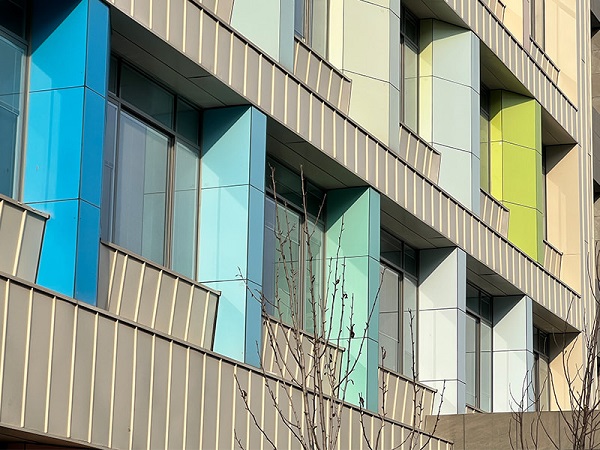
Compact Laminate vs High-Pressure Laminate (HPL)
High-pressure laminate and Compact laminate share similar manufacturing processes but differ significantly in structure and application capabilities. Standard HPL requires bonding to a substrate like particleboard or MDF, while Compact laminate stands alone as a structural material.
Performance Comparison
| Feature | Compact Laminate | High-Pressure Laminate |
|---|---|---|
| Thickness Range | 2-25mm | 0.6-1.5mm (requires substrate) |
| Moisture Resistance | Excellent (suitable for wet areas) | Good (depends on substrate) |
| Impact Resistance | Superior (homogeneous core) | Moderate (substrate dependent) |
| Self-Supporting | Yes | No |
| Edge Treatment | Color-through (no edgebanding) | Requires edgebanding |
| Typical Cost (per sq ft) | $12-18 | $4-8 (plus substrate) |
The structural integrity of Compact laminate eliminates substrate-related failures common with HPL installations. Delamination at edges, moisture penetration through seams, and core swelling—frequent issues with particleboard-backed HPL—are virtually eliminated with solid HPL construction.
For applications like laboratory benchtops, bathroom partitions, and outdoor furniture, Compact laminate provides significant longevity advantages. Performance studies on building materials indicate that self-supporting laminates demonstrate extended service life in institutional settings compared to substrate-dependent alternatives.
Compact Laminate vs Solid Surface Materials
Solid surface materials like acrylic-based composites offer seamless installation and repairability, presenting a different value proposition compared to Compact laminate.
Cost and Maintenance Analysis
Solid surface materials typically cost between $45-110 per square foot installed, significantly higher than Compact laminate's $20-30 per square foot installed cost. This price differential becomes substantial in large-scale projects like educational facilities or healthcare installations.
However, solid surfaces offer unique repair advantages. Scratches and minor damage can be sanded out, restoring the original appearance. Compact laminate, while highly scratch-resistant, cannot be repaired through sanding without compromising the decorative layer.
| Characteristic | Compact Laminate | Solid Surface |
|---|---|---|
| Heat Resistance | Moderate (up to 160°C brief contact) | Lower (up to 135°C) |
| Chemical Resistance | Excellent (wide range) | Good (susceptible to some solvents) |
| Seamless Joints | No (visible seams) | Yes (seamless appearance) |
| Repairability | Limited (replace damaged section) | Excellent (sanding/polishing) |
| Bacterial Resistance | Excellent (non-porous) | Excellent (non-porous) |
| Design Flexibility | Wide color/pattern range | Moderate color range |
For laboratory applications requiring frequent chemical exposure, Compact laminate demonstrates superior resistance. Laboratory safety guidelines published by the Occupational Safety and Health Administration emphasize selecting materials that withstand chemical exposure without degradation when designing laboratory workspaces.
Compact Laminate vs Natural Stone
Natural stone materials like granite and marble represent the premium segment of surface materials, offering distinctive aesthetics at significantly higher costs and maintenance requirements.
Practical Performance Factors
Granite countertops cost approximately $50-120 per square foot installed, while marble ranges from $60-180 per square foot. Both materials require periodic sealing to maintain stain resistance—a maintenance task unnecessary with Compact laminate's factory-finished surface.
Weight considerations also favor Compact laminate. At approximately 1.4-1.5 grams per cubic centimeter, Compact laminate weighs roughly half that of granite (2.65-2.75 g/cm³), reducing structural load requirements and installation complexity. This weight advantage becomes critical in renovation projects where existing structural capacity may be limited.
Natural stone's porosity varies by type, with marble particularly susceptible to acidic substances. Coffee, wine, and citrus juices can cause etching and staining on unsealed or improperly maintained stone surfaces. Compact laminate's impervious surface eliminates these concerns, making it preferable for high-use commercial kitchens and dining areas.
| Factor | Compact Laminate | Granite | Marble |
|---|---|---|---|
| Stain Resistance | Excellent (no sealing needed) | Good (requires sealing) | Poor to Moderate |
| Maintenance Frequency | Minimal (routine cleaning) | Annual sealing recommended | Biannual sealing required |
| Consistency | Uniform appearance | Natural variation | Natural variation |
| Installation Weight | Lightweight | Heavy (structural considerations) | Heavy |
| Acid Resistance | Excellent | Good | Poor (etches easily) |
| Environmental Impact | Moderate (manufacturing energy) | High (quarrying, transport) | High (quarrying, transport) |
Compact Laminate vs Melamine and Particle Board
Melamine-faced particle board represents the economy option in surface materials, offering significantly lower initial costs but compromised performance in demanding environments.
Durability and Lifecycle Considerations
Melamine costs approximately $3-6 per square foot, making it attractive for budget-conscious projects. However, its particleboard core presents significant moisture vulnerability. When exposed to water, particle board swells and deteriorates, leading to premature failure in bathroom, kitchen, or outdoor applications.
Edge protection becomes critical with melamine. Unlike Compact laminate's solid-color core visible at edges, melamine's particleboard core requires edgebanding. These edges represent failure points where moisture infiltration commonly begins, particularly in areas subject to cleaning or water exposure.
The lifespan differential significantly impacts total cost of ownership. While melamine might last 3-7 years in commercial applications, Compact laminate typically provides 15-25 years of service under similar conditions. Lifecycle cost analysis principles emphasize evaluating replacement frequency and maintenance requirements rather than focusing solely on initial material costs.
Compact Laminate vs Stainless Steel
Stainless steel surfaces dominate certain commercial applications, particularly in food service and medical environments, but Compact laminate offers compelling advantages in specific scenarios.
Application-Specific Performance
Stainless steel provides unmatched heat resistance and seamless integration in commercial kitchens. However, its cost ($65-180 per square foot installed), susceptibility to scratching and denting, and tendency to show fingerprints limit its appeal in certain applications.
Compact laminate offers superior acoustic properties, absorbing rather than amplifying sound—an advantage in educational and healthcare settings where noise control matters. Steel's reflective properties can create glare issues under certain lighting conditions, while Compact laminate's matte finishes reduce visual fatigue.
| Application Factor | Compact Laminate | Stainless Steel |
|---|---|---|
| Heat Resistance | Moderate (160°C brief) | Excellent (500°C+) |
| Scratch Visibility | Low (textured finishes) | High (shows every mark) |
| Acoustic Properties | Sound-absorbing | Sound-amplifying |
| Design Flexibility | Extensive colors/patterns | Limited (metallic finishes) |
| Corrosion Concerns | None | Possible in harsh environments |
| Warmth (tactile) | Neutral temperature feel | Cold to touch |
For environments requiring frequent sanitization but not direct heat exposure, Compact laminate's non-porous surface provides comparable hygiene benefits at substantially lower cost and with improved aesthetic versatility.
Environmental and Sustainability Considerations
Sustainability increasingly influences material selection decisions, with Compact laminate presenting both advantages and challenges in environmental impact assessment.
Lifecycle Environmental Impact
Modern Compact laminate manufacturing often incorporates recycled paper content and uses formaldehyde-free resins, addressing previous environmental concerns. Many products now meet standards for indoor air quality and low-emitting materials established by environmental agencies.
The extended service life of Compact laminate reduces replacement frequency, lowering the cumulative environmental impact compared to shorter-lived alternatives like melamine. When calculating environmental impact, the material's durability and maintenance requirements throughout its lifecycle provide more accurate assessment than production impacts alone.
End-of-life disposal presents challenges for most surface materials. While Compact laminate is not biodegradable, some manufacturers have established recycling programs. Natural stone can be repurposed but requires significant energy for transport and processing. Stainless steel offers excellent recyclability but high embodied energy from initial production.
Cost Analysis: Total Ownership Perspective
Understanding true material costs requires examining initial investment, installation expenses, maintenance requirements, and expected lifespan—factors that often reverse initial price advantage perceptions.
| Material | Initial Cost/sq ft | Expected Lifespan | Annual Maintenance | 20-Year Total Cost |
|---|---|---|---|---|
| Compact Laminate | $20-30 | 15-25 years | $0.40/sq ft | $28-38/sq ft |
| Melamine | $8-12 | 3-7 years | $0.25/sq ft | $35-52/sq ft |
| Solid Surface | $45-110 | 20+ years | $0.80/sq ft | $61-126/sq ft |
| Granite | $50-120 | 20+ years | $1.80/sq ft | $86-156/sq ft |
| Stainless Steel | $65-180 | 20+ years | $1.20/sq ft | $89-204/sq ft |
Note: Costs represent typical commercial installation ranges. Actual costs vary by region, project scale, and specific product selection. Maintenance costs include cleaning, sealing (where applicable), and minor repairs.
The 20-year analysis reveals that melamine's lower initial cost becomes a liability when replacement cycles are factored. Compact laminate's moderate initial investment coupled with minimal maintenance and long service life often delivers the best total cost performance for commercial applications.
Application-Specific Recommendations
Material selection should align with specific environmental conditions and performance priorities rather than following a one-size-fits-all approach.
Healthcare and Laboratory Settings
Compact laminate excels in healthcare environments where chemical resistance, easy sanitization, and moisture resistance are paramount. Its non-porous surface prevents bacterial harboring, while chemical resistance accommodates frequent disinfectant use. The material's dimensional stability ensures consistent performance despite humidity fluctuations common in medical facilities.
Educational Facilities
Schools and universities benefit from Compact laminate's impact resistance and graffiti resistance. The ability to withstand heavy use without showing wear makes it ideal for classroom desktops, cafeteria tables, and locker areas. Cost considerations favor Compact laminate over premium materials given budget constraints typical in educational procurement.
Commercial Kitchens
For food preparation areas not involving direct heat application, Compact laminate provides cost-effective performance. However, stainless steel remains preferable for surfaces adjacent to cooking equipment where heat resistance is critical. A hybrid approach using stainless steel near heat sources and Compact laminate for preparation areas optimizes both performance and budget.
High-End Residential
Residential applications prioritizing aesthetics often favor natural stone or solid surface materials despite higher costs. However, Compact HPL laminate's expanding design options—including realistic stone and wood grain patterns—make it increasingly viable for budget-conscious homeowners seeking contemporary aesthetics.
Installation and Fabrication Considerations
The ease of installation and fabrication requirements impact both material suitability and project costs. Compact HPL laminate's working characteristics differ significantly from alternatives, affecting labor requirements and specialized equipment needs.
Unlike natural stone requiring specialized cutting equipment and skilled fabricators, Compact HPL laminate can be worked with standard woodworking tools. This accessibility reduces installation costs and allows for easier on-site modifications. However, proper edge treatment and joint sealing require attention to detail for optimal performance and appearance.
Solid surface materials demand specialized training for seamless joint creation and thermoforming. While offering design flexibility, these requirements increase labor costs and limit the contractor pool capable of proper installation. Compact HPL laminate's simpler installation process broadens contractor availability and potentially accelerates project timelines.
Conclusion
Selecting between Compact HPL laminate and alternative surface materials requires balancing performance requirements, budget constraints, aesthetic preferences, and long-term maintenance considerations. HPL laminate emerges as the optimal choice for applications demanding moisture resistance, chemical resistance, and durability at moderate cost—particularly in commercial, educational, and healthcare environments.
While premium materials like natural stone and solid surfaces offer unique advantages in specific applications, Compact HPL laminate provides the most balanced performance-to-cost ratio for most institutional and commercial projects. Its superior performance compared to economy options like melamine justifies the modest price premium through extended service life and reduced maintenance requirements.
The key to successful material selection lies in thoroughly evaluating project-specific requirements rather than defaulting to familiar options or lowest-cost alternatives. Understanding the genuine performance differences between materials—backed by empirical data rather than marketing claims—enables informed decisions that optimize both immediate and lifecycle value.
Frequently Asked Questions
Can Compact HPL laminate be used outdoors?
Yes, Compact laminate is suitable for outdoor applications including furniture, partitions, and cladding. Its UV resistance and moisture resistance make it more durable outdoors than standard laminates or melamine. However, direct sun exposure may cause slight color fading over extended periods.
How does Compact laminate compare to quartz countertops?
Quartz offers superior heat resistance and a more premium appearance but costs significantly more ($70-180/sq ft vs. $20-30/sq ft for HPL laminate). Both are non-porous and low-maintenance, but Compact laminate is lighter and easier to install, while quartz provides better scratch resistance and perceived value in residential applications.
What thickness of Compact laminate is best for different applications?
Thickness selection depends on usage: 6-8mm works for wall panels and low-stress applications; 10-13mm suits standard countertops and tables; 16-25mm is recommended for laboratory benchtops, high-traffic surfaces, and applications requiring self-supporting spans.
Is Compact laminate resistant to mold and bacteria?
Yes,Compact laminate's non-porous surface prevents bacterial penetration and does not support mold growth. This makes it ideal for healthcare, food service, and high-humidity environments. Regular cleaning with standard disinfectants maintains hygienic surfaces without special treatments.
Can scratches on Compact laminate be repaired?
Minor scratches can sometimes be minimized with specialized laminate repair kits, but deep scratches cannot be fully repaired like solid surface materials. The solid-color core construction means scratches are less visually prominent than on materials with substrate cores. Prevention through textured finishes is the best approach.
What is the difference between Compact laminate and phenolic resin panels?
HPL laminate is a type of phenolic resin panel made specifically from layered kraft paper and phenolic resins. The terms are often used interchangeably, though "HPL laminate" typically refers to decorative-surfaced products, while "phenolic resin panels" may refer to industrial-grade products without decorative faces.
CATEGORIES:

 Contact Us
 Online Sales
 Case Study
 News Center
 Product Brochure