Compact Laminate Material vs HDPE vs wood outdoor tabletops compared

This comparison evaluates three exterior-grade tabletop materials, exterior compact laminate, HDPE, and outdoor wood, against the same criteria: weathering and UV performance, fire classification, hygiene and emissions, thickness and support requirements, and documentation readiness. Criteria drive the structure, not material preference.
The category is growing. Spherical Insights[1] estimated the global recycled plastic outdoor furniture market at USD 5.91 billion in 2025, projecting USD 10.9 billion by 2035 at a 6.31% CAGR, with HDPE accounting for 42.3% of volume. That figure covers the recycled-plastic outdoor furniture category, not HDPE tabletops specifically.
Key Takeaways
Criteria come before materials: weathering, fire, hygiene, thickness and documentation are assessed in the same order for all three options.
Exterior grade must be confirmed per SKU, since interior and exterior compact laminate share a product family but not a specification.
No single material wins every project; the head-to-head section maps each option to the conditions it suits.
Performance and Standards Framework
Three criteria decide whether an outdoor tabletop survives its warranty period: how the surface handles UV and water, how it behaves in a fire, and whether it can be kept hygienic. Each maps to a published standard, so a specification can be checked rather than argued about.

Weathering and UV Criteria
Exterior use is a material grade, not a finish. Standard or interior compact laminate should not be assumed suitable outdoors; exterior applications require a confirmed exterior-grade panel, and EN 438-6[2] is the part that sets the requirements for exterior-grade compact laminate. The wider EN 438 family separates the two: EN 438-2 defines the test methods[3] for high-pressure decorative laminates, while EN 438-4 covers interior compact laminate of 2 mm and above. Ask which part a supplier's panel is actually certified to.
Fire Classification Context
An outdoor tabletop fire rating EN 13501-1 is a reaction-to-fire classification, not an outdoor-suitability label and not the same thing as fire resistance, which sits in EN 13501-2. MeasurLabs explains the classes[4] as A1, A2, B, C, D, E and F, with smoke suffixes s1 to s3 and flaming-droplet suffixes d0 to d2. The full designation, for example A2-s1,d0, is what an approver reads. The A classes carry measurable thresholds: class A1 requires EN ISO 1182 non-combustibility and a gross heat of combustion under 2.0 MJ/kg, while class A2 allows a gross calorific potential of no more than 3.0 MJ/kg.
Hygiene and Emissions
Hygiene and emissions requirements vary by market and by project type, so the framework question is narrower: can the supplier produce a current test report for the specific panel and thickness being specified? Where that documentation does not exist for a material, treat cleanability as an open item rather than an assumed property.
Exterior Compact Laminate (HPL)
Compact laminate is a high-pressure laminate (HPL): layers of resin-impregnated kraft paper compressed under heat and pressure into a thick, homogeneous, self-supporting panel, also known as solid phenolic. Roughly 70% of that build is wood-fibre kraft paper, increasingly recycled, saturated with thermoset phenolic resin and capped with a melamine decor layer. Because the core is resin-saturated rather than glued fibreboard, an exterior grade compact laminate tabletop resists water, fading, heat and frost, with strong UV resistance, and panels are manufactured from 3 mm to 18 mm. Scratch resistance and rigidity follow from the same density: there is no veneer to lift and no core to swell at a chipped corner.
Fire and Hygiene Documentation
Exterior-grade compact laminate and solid phenolic HPL commonly reach EN 13501-1 B-s1,d0 at thicknesses of 10 mm and above, with some tested systems at B-s2,d0; by comparison, wood products are typically class D and HDPE typically class E unless flame-retarded. That gap is the reason an outdoor tabletop fire rating EN 13501-1 is worth confirming in writing rather than assuming from the material name.
Thickness and Support Guidance
Compact laminate is joined as a finished component, so edge detailing, fixing method and support structure matter as much as the panel itself. Outdoor ranges commonly sell thicker tops, one line listing 13 mm for horizontal use, and buyers should confirm the top is rated for horizontal use rather than for cladding.
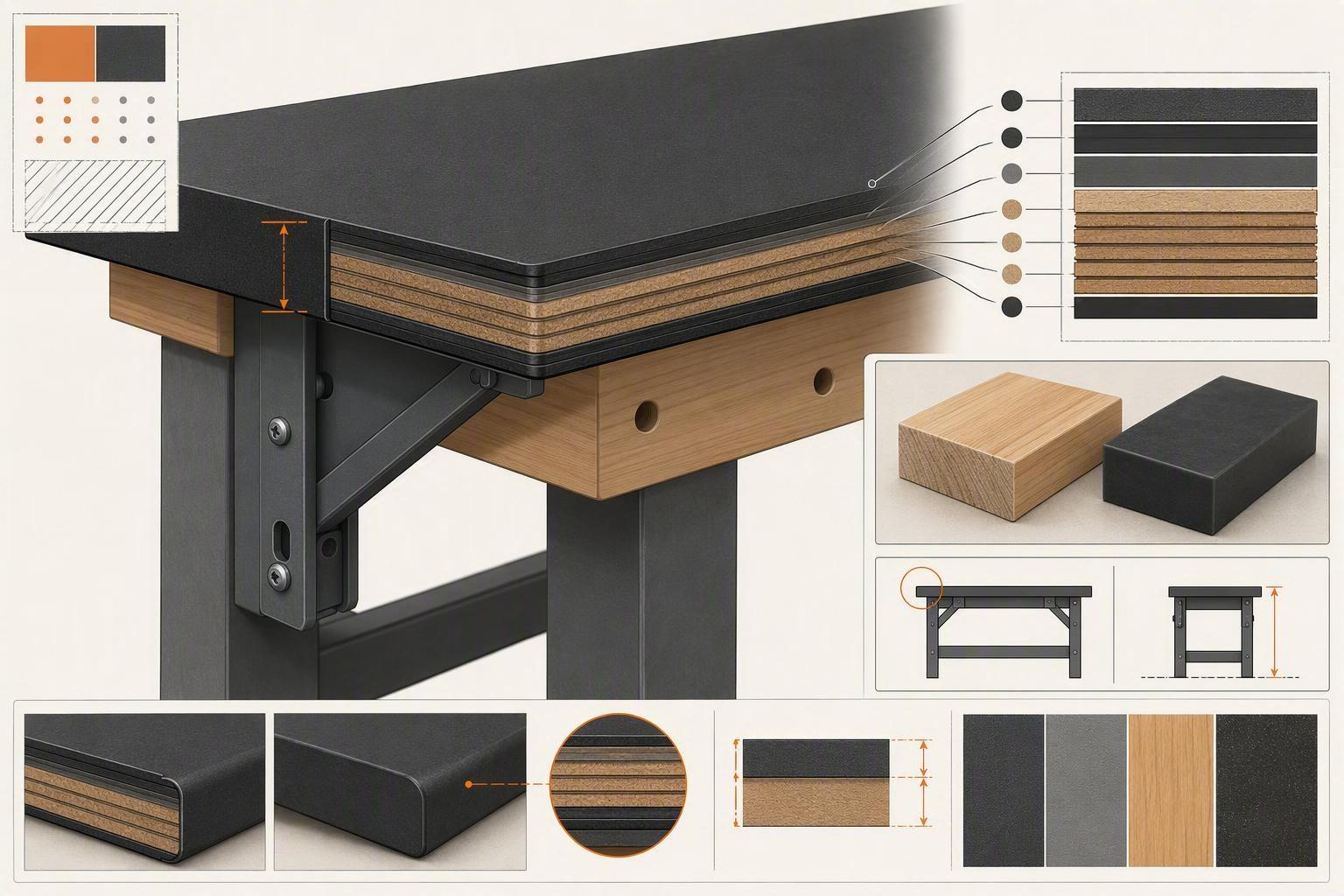
As one replicable example, Huajiale supplies a commercial outdoor dining table with a 12 mm exterior-grade HPL top on a heavy-duty powder-coated cast iron pedestal base, at 1450-1500 kg/m³ density, documented to EN 438-6 and GB/T 7911, with the fire classification stated by the manufacturer as B-s2,d0 under EN 13501-1, and available in 3,000+ color options with OEM and custom sizes. The stated classification and panel properties are the manufacturer's claims and should be confirmed against the panel's own test file. Compact laminate still needs sealed edges, protected joints and planned drainage, since standing water at an exposed edge is where these tops fail first.
HDPE for Outdoor Tabletops
HDPE is the low-maintenance option in this comparison, and the material's weak points are predictable: UV stabilization quality, fire class, and stiffness under span.
UV Stabilization and Mechanical Properties
HDPE outdoor tabletop UV stabilization is compounded into the resin, not coated on the surface, so it cannot wear off the way paint does. The main systems are carbon black, which screens UV strongly but darkens the part, and HALS, a radical scavenger that can regenerate and suits coloured or natural-look tops (pom-material, "HDPE UV Resistance"[5], retrieved 2026-08-13). Carbon black content is specified at 2.0% to 3.0% for UV screening under ASTM D3350-21[6], with HALS loading typically 0.1% to 0.6%. That specification is also where the risk sits. Unstabilized HDPE can fade, chalk, embrittle and lose toughness, and lot-to-lot variation matters: a compound drifting from 2.5% to 1.8% carbon black may look identical in the bag but can shorten service life. Ask for the carbon black figure per delivery lot.
Fire Behavior and Compliance Notes
HDPE is a combustible thermoplastic. Standard polyethylene is not a B-class material without additives, so where the specification calls for B-s1,d0, buy an explicitly flame-retardant grade rather than assuming the standard one qualifies.
Thickness, Support Spacing, Stiffness
HDPE is the least stiff of the three materials, so support spacing and thickness carry more of the load. Well-made HDPE tops are commonly rated for roughly 15 to 25 years outdoors in residential use, with some suppliers claiming 20 years or more for quality products. No independent test data on commercial-duty spans was found for this section, so confirm deflection limits with the supplier against your own frame spacing.
Outdoor Wood Options
Wood remains a legitimate choice for exterior tabletops where appearance and repairability matter more than a fixed maintenance schedule. The trade-off is that species selection and finishing system determine how much upkeep the top will need.
Species and Finishing Systems
Teak sits in the top durability class under EN 350, the European standard for natural durability of wood. Left unfinished, teak weathers to a silver-grey patina, which is a cosmetic change rather than decay. Oiling roughly once a year holds its original colour. Other species used outdoors, including iroko, robinia and thermally modified pine, sit lower in the durability classes and depend more heavily on the finish system. A penetrating exterior oil, stain, sealant or saturator is what keeps water out of the grain; film-forming varnishes tend to crack and trap moisture once they fail.
Maintenance Cycles and Hygiene
Outdoor wood tabletop maintenance follows a recurring cycle rather than a one-off treatment. Gardenista's wood furniture care guide[7] and B&Q's garden furniture guidance describe the same routine: clean with mild soap and water, dry the surface completely, refresh the exterior finish, and sand lightly with fine paper, not steel wool, before refinishing. Shelter the top from prolonged direct sun and heavy rain. In food-service settings, that drying step is the hygiene-critical one, because a damp, oiled surface holds moisture in the grain.
Fire and Sustainability Certifications
Wood's fire performance depends on species, thickness and any applied flame-retardant treatment, so a generic classification cannot be quoted for the material family. No verified evidence for a wood outdoor tabletop fire classification under EN 13501-1 or ASTM E84 was found for this comparison. Buyers specifying for commercial projects should request the supplier's test report for the exact species and treatment, plus FSC or PEFC chain-of-custody documentation if certified sourcing is required.
Head-to-Head Comparison: Compact Laminate vs HDPE vs Wood
The compact laminate vs HDPE vs wood outdoor tabletops decision usually comes down to which material clears the submittal stage. The matrix below sets each option against the same criteria used above.
| Criterion | Exterior compact laminate | HDPE | Outdoor wood |
|---|---|---|---|
| Best for | Commercial terraces, hospitality dining | Coastal and poolside settings | Appearance-led residential briefs |
| Exterior grade | EN 438-6 / GB/T 7911, 12 mm | UV-stabilized grade stated by supplier | Species durability class plus finish system |
| Fire classification | Manufacturer states B-s2,d0 | Typically class E unless flame-retarded | Typically class D |
| UV behaviour | Decor layer, colour stable under normal exposure | Needs UV stabilization to resist chalking | Greys without a pigmented finish |
| Maintenance | Wipe-down cleaning | Periodic cleaning | Re-oiling on a recurring cycle |
| Thickness and support | 12 mm typical, spacing per supplier | Thicker sections for equal stiffness | Section and span set by species |
| Documentation | Product standard, fire class, hygiene statements | Fire test report often requested separately | Species, finish and treatment records |
| Verdict | Strongest documentation package | Strongest for wet, salt-exposed sites | Strongest for appearance-led briefs |
Durability and Maintenance Trade-Offs
No material wins outright. Compact laminate and HDPE both avoid the recurring refinishing cycle that defines outdoor wood ownership, which matters most where access for maintenance is difficult. Wood stays competitive on repairability: a sanded and re-oiled surface can be brought back, whereas a damaged decor layer on a laminate panel is generally replaced rather than restored. The comparison here is maintenance burden, not lifespan; HDPE's service life is covered above.
Compliance and Documentation Readiness
This is where the three diverge most sharply, and it is usually what the approver asks about first. Compact laminate arrives with a product standard and a stated fire class. HDPE and wood do not carry an equivalent single package. Wood products are typically class D, and HDPE typically class E unless flame-retarded, so both usually need a separate test report or treatment record before sign-off on a commercial project.
Cost and Lead-Time Considerations
Unit price alone misleads. Wood carries the lowest material cost but the highest lifetime cost once refinishing labour is counted. HDPE sits mid-range with low maintenance but thicker sections for equivalent stiffness. Compact laminate costs most per panel but needs no finishing trade on site. For reference, Huajiale quotes standard-color lead times of 15-20 days, custom colors 20-30 days, and 30-45 days for large projects, against a monthly manufacturing capacity of 80,000 m² with CNC machining, OEM/ODM, and project engineering support. Lead time also depends on whether the fire and hygiene documents are already on file; requesting them late is the most common cause of delay.
Procurement Checklist and Specification Notes
Documentation Requirements
Ask for the panel's own test file before you compare prices. A supplier should confirm in writing that the top is rated for horizontal use, not just for cladding or vertical panels, since the same material family can carry different approvals depending on how it is mounted and loaded. Exterior applications also require a confirmed exterior-grade panel rather than an interior grade with a weather-resistant coating. For an exterior grade compact laminate tabletop, the file should name the product standard and the fire classification separately. Manufacturers sometimes merge them: one catalogue line records an outdoor dining table with a 12 mm exterior-grade HPL top as carrying an "EN438 13501 b-s2 d0 fire rating," which conflates the EN 438 product standard with the EN 13501-1 fire classification. Read the stated class as B-s2,d0 and ask which standard each document actually tests against.
Installation and Cleaning Instructions
Request the fixing detail, the support spacing and the cleaning agents the manufacturer permits. Confirm who supplies the edge treatment and who accepts responsibility for drainage at the frame.
Warranty and Supplier Verification
Get the warranty term, the exclusions and the named after-sales contact in writing, plus a batch colour and density tolerance statement before you release a repeat order.
Conclusion
The selection logic runs in three passes, and the material that survives all three is the one to specify. First, match the material to the exposure: full sun and standing water at the edge, or a covered terrace with occasional rain. Second, confirm the compliance file meets the project's authority: fire classification to EN 13501-1, hygiene and emissions documentation, and a test report that names the exact SKU. Third, price the maintenance interval, because that interval, not the purchase price, drives total cost of ownership over a ten-year fit-out cycle.
Who should choose which: specify exterior grade compact laminate tabletop where documentation depth, scratch resistance and rigidity at thin sections matter most, and where edge sealing and drainage can be detailed correctly. Choose HDPE outdoor tabletop UV stabilization where impact tolerance and low maintenance outweigh stiffness. Choose wood where the finish is the design intent and a refinishing cycle is acceptable. Verify exterior-grade certification per SKU, not per material family. Changzhou Huajiale Decorative Materials Co., Ltd. supplies exterior HPL in 12 mm documented to EN 438-6 and GB/T 7911 with a stated B-s2,d0 class, and the same check applies to every alternative you shortlist. Talk to a technical specialist about your project's exposure and compliance requirements.
Need a Compact Laminate Tabletop That Meets Your Specification?
Whether you are specifying for a commercial terrace or a coastal project, our technical team can confirm the exterior grade, fire classification and support details for the exact panel you need. Share your project requirements and get a tailored recommendation with test documentation.
References
Spherical Insights — Global Recycled Plastic Outdoor Furniture Market Outlook (2026–2035). https://www.sphericalinsights.com/blogs/top-25-companies-in-global-recycled-plastic-outdoor-furniture-market-2026-2035-expert-view-by-spherical-insights
Material Intelligence — Compact Laminate Guide. https://materialintelligence.com/guides/compact-laminate/
iTeh Standards — SIST EN 438-2:2016+A1:2019 High-Pressure Decorative Laminates, Test Methods. https://standards.iteh.ai/catalog/standards/sist/7ca0197c-7e6b-40ae-a260-a97bc75221b1/sist-en-438-2-2016a1-2019
MeasurLabs — EN 13501-1 Fire Classification: Performance Classes and Criteria. https://measurlabs.com/blog/en-13501-1-fire-classification-performance-classes-and-criteria/
pom-material — HDPE UV Resistance (retrieved 2026-08-13). https://pom-material.com/blog/hdpe-uv-resistance/
ASTM International — ASTM D3350-21, Standard Specification for Polyethylene Plastics Pipe and Fittings Materials. https://www.astm.org/d3350-21.html
Gardenista — Hardscaping 101: How to Clean, Care For, Protect and Cover Wood Outdoor Furniture. https://www.gardenista.com/posts/hardscaping-101-how-to-clean-care-for-protect-cover-wood-outdoor-furniture/
CATEGORIES:

 Contact Us
 Online Sales
 Case Study
 News Center
 Product Brochure