Picture this: a beautiful wooden dining table, now marred by stubborn water rings from forgotten coasters. Or a cheap laminate surface, scratched and faded after just months of use. Many homeowners face this dilemma—they want tabletops that look attractive without demanding constant care. This is where HPL tabletops enter the picture. High-Pressure Laminate offers a practical balance of visual appeal and durable performance.
This beginner's guide explains HPL tabletops, covering what makes them a smart choice for indoor and outdoor settings. Readers will discover how this material differs from standard laminates and how it serves as a low-maintenance surface solution. By the end, anyone can confidently decide whether HPL suits their space.
HPL tabletops have multiple resin-saturated layers that make them strong and durable.
HPL generally resists scratches, impacts, and stains better than standard low-pressure laminate.
You can clean HPL tabletops easily with mild soap and water.
HPL works well for kitchens, offices, dining areas, and (in exterior grade) outdoor settings.
Exterior-grade HPL resists UV fading and moisture better than standard laminate, though long-term outdoor exposure may still cause gradual color change.
Common attachment methods include metal brackets, Z-clips, direct screwing, and adhesive.
Look for EN 438 compliance when choosing an HPL manufacturer [1].
Trusted makers like HUAJIALE offer many colors and custom sizes.
What Is an HPL Tabletop?
High-Pressure Laminate, commonly called HPL, is a surface material produced through a controlled manufacturing process. Manufacturers fuse multiple layers of kraft paper saturated with phenolic resin, then top this core with a decorative layer and a protective overlay. The result is a dense, durable sheet that serves as the surface layer for finished products known as HPL tabletops. These tabletops feature a slim profile yet possess good strength, making them a popular choice for homes and businesses alike.
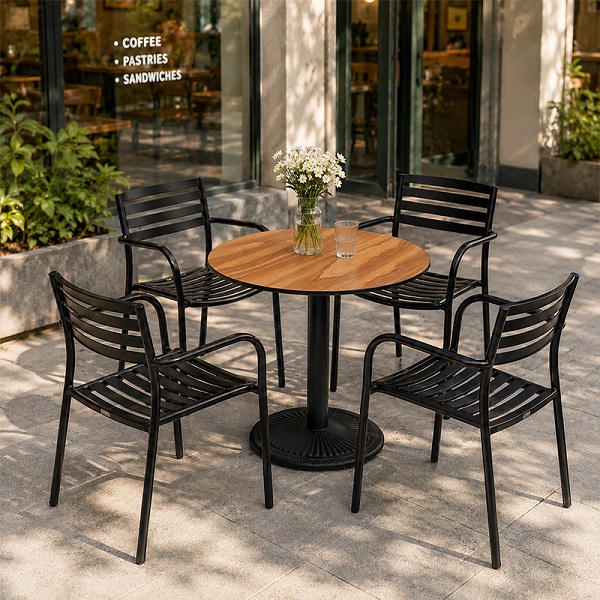
Breaking Down the Layers
Understanding HPL starts with examining its construction. Each layer plays a specific role in the material's overall performance. The combination of these layers creates a product that outperforms many alternative surfaces.
The Decorative Paper
The decorative paper gives HPL its visual appeal. This layer carries the design—whether wood grain, solid color, or pattern. Manufacturers print this paper using high-resolution techniques that replicate natural materials with good accuracy. The paper sits beneath a transparent protective overlay, which helps shield it from fading, scratching, and everyday wear. This positioning helps the surface maintain its appearance over time, even in demanding environments.
The Kraft Paper Core
Beneath the decorative layer lies the kraft paper core. This brown paper, saturated with phenolic resin, provides the structural backbone of the laminate. Multiple sheets stack together, each adding thickness and strength. The number of layers directly influences the final product's density and impact resistance. During manufacturing, heat and pressure fuse these sheets into a solid, cohesive mass. This core gives high-pressure laminate its characteristic rigidity and ability to withstand heavy use without bending or warping.
The Protective Overlay
The protective overlay serves as the first line of defense. This transparent layer sits on top of the decorative paper, forming a clear shield against external forces. It helps resist scratches, moisture, stains, and moderate heat. Manufacturers formulate this overlay with melamine resin that enhances durability without compromising clarity. When someone places a hot plate or spills red wine on an HPL surface, this overlay helps protect the decorative layer beneath. This protective barrier contributes significantly to the material's low-maintenance reputation.
HPL vs. Standard Laminate
Many people confuse HPL with standard laminate, but significant differences separate these materials. Standard laminate, often called low-pressure laminate (LPL), uses fewer layers and undergoes a less intense manufacturing process. Manufacturers apply it directly to particleboard or MDF substrates, creating a thinner, less durable surface.
HPL, by contrast, undergoes a more rigorous production process. The high-pressure pressing stage compresses layers at a pressure of approximately 5–12 MPa while applying temperatures of 120–150°C. This process creates a denser, more resilient material. Standard HPL sheets (typically 0.6–1.2 mm thick) are usually bonded to a substrate such as particleboard or MDF. Compact HPL (also called compact laminate, typically 5–20 mm thick) can stand alone without additional substrate support due to its greater thickness and rigidity.
The lifespan difference between these materials can be significant. In commercial settings, HPL tabletops typically last 8 to 12 years with proper care. Standard laminate tabletops in commercial use may average 5 to 6 years. Actual lifespan depends on usage intensity, maintenance practices, and whether the surface is protected from extreme heat and sharp impacts.
| Property | HPL (High-Pressure Laminate) | Standard LPL (Low-Pressure Laminate) |
|---|---|---|
| Pressing Pressure | 5–12 MPa | Approx. 1–2 MPa |
| Typical Thickness | 0.6–1.2 mm (standard); 5–20 mm (compact) | 0.5–1.0 mm |
| Substrate Required | Yes (thin sheets); No (compact grade) | Yes (always bonded to board) |
| Abrasion Resistance | Higher | Moderate |
| Typical Commercial Lifespan | 8–12 years | 5–6 years |
For beginners weighing options, the choice often comes down to application. Standard laminate works adequately for light residential use. HPL, however, offers superior durability for high-traffic areas and commercial environments where longevity matters.
Why Density Matters for Durability
Density serves as a key indicator of quality in laminate products. Higher-density materials resist impacts, help prevent moisture absorption, and maintain structural integrity over time. Quality HPL products achieve densities that reflect the compression of multiple resin-saturated layers.
This density translates into real-world performance. A compact HPL tabletop with proper density can withstand dropped plates, dragged chairs, and heavy daily use without showing significant wear. Lower-density laminates may compress more easily under pressure, leading to dents, surface deformation, and eventual failure.
Density also affects how the material handles moisture. Dense HPL resists water penetration at edges and surfaces, helping prevent the swelling and delamination that can affect lesser products. This moisture resistance is especially valuable in dining areas where spills happen regularly.
When evaluating tabletops, checking for compliance with rigorous industry standards such as EN 438 provides confidence in the product's durability and expected lifespan [1].
How Are HPL Tabletops Manufactured?
The manufacturing process transforms raw materials into a dense, durable surface through carefully controlled steps. Each stage contributes to the final product's performance and longevity. Understanding these steps helps buyers appreciate why HPL tabletops offer reliable service.
The Saturation Process
The journey begins with saturating the core materials. Rolls of kraft paper pass through baths of phenolic resin, absorbing the liquid until fibers reach sufficient impregnation. The kraft paper must receive enough resin to bond properly during pressing without becoming oversaturated and weak.
Decorative papers undergo similar treatment with melamine resin. These papers carry the visual design for the finished tabletop. The melamine resin contributes to surface hardness and stain resistance, protecting the decorative layer beneath.
In HPL production, kraft paper is typically impregnated with phenolic resin to achieve a resin content of approximately 30–50% by weight. This range ensures proper resin uptake without causing fiber deformation from excessive soaking.
After saturation, the papers dry partially, leaving the resin in a semi-cured state called B-stage. The resin remains reactive enough to flow during final pressing yet stable enough for handling and stacking between production steps.
The High-Pressure Pressing Stage
Assembled layers stack into a hydraulic press with multiple kraft sheets forming the core. The decorative paper sits on top, followed by the protective overlay. The press applies both heat and pressure simultaneously.
Typical pressing pressure ranges from 5 MPa to 12 MPa
Processing temperatures reach 120–150°C
Heat and pressure cause the resin to melt, flow, and cure into a cross-linked network
The high pressure compresses the stack into a fraction of its original thickness. Multiple layers fuse into a single solid sheet. The resin cross-links into a thermoset plastic that cannot remelt under normal conditions. This thermoset nature gives high-pressure laminate its good resistance to heat and impact.
After a controlled cooling period while still under pressure, the resin achieves final cure. Controlled cooling helps prevent internal stresses and warping. Manufacturers then cut these large sheets into standard sizes or custom dimensions for tabletop fabrication.
Quality Standards and Certifications
Industry standards provide a reliable benchmark for evaluating HPL products. EN 438 is the primary European standard for decorative high-pressure laminates, specifying requirements for thickness, density, dimensional stability, surface resistance, and fire performance [1]. Products meeting these standards deliver consistent quality across production batches.
Reputable manufacturers adhere to these standards. For beginners evaluating suppliers, checking for compliance offers confidence in material durability and safety. Certified products undergo testing for impact resistance, scratch resistance, stain resistance, and dimensional stability under varying conditions.
Fire ratings matter particularly for commercial applications. Fire-retardant grade HPL can achieve a classification indicating limited contribution to fire development with no flaming droplets (e.g., EN 13501-1 class B-s1,d0), making it suitable for restaurants, hotels, cafés, and other public spaces where safety regulations apply. Note that standard (non-fire-retardant) HPL may have a lower fire classification, so buyers should verify the specific grade for their project.
Density certification confirms material quality. Proper compression ensures resistance to moisture penetration and structural deformation. Lower-density products may absorb water at edges or develop surface depressions under heavy use.
When sourcing tabletops, requesting certification documentation and test reports helps verify the manufacturer's claims.
Looking for EN 438-Certified HPL Tabletops for Your Project?
HUAJIALE offers high-pressure laminate tabletops with customizable colors, sizes, and edge profiles, plus OEM/ODM capabilities for commercial and residential projects. Contact their team for samples and bulk pricing.
Request Samples & Free QuoteWhy Choose HPL Tabletops? Key Benefits
Selecting a surface material involves weighing multiple factors. Durability, cleaning effort, and appearance all matter. HPL tabletops deliver strong performance across each category. Understanding these advantages helps buyers make confident decisions for homes or businesses.
Built to Last: Scratch and Impact Resistance
Daily life takes a toll on table surfaces. Dropped utensils, sliding plates, and shifting chairs create wear over time. HPL resists these forces through its dense, compressed construction. The material's layered structure helps distribute impact energy across a wide area, reducing localized damage.
Scratches represent one of the most common complaints about tabletops. Standard surfaces may show fine lines after months of use. HPL performs differently. The protective overlay creates a hard barrier that resists abrasion from everyday objects. Keys, ceramic dishes, and metal cutlery can slide across the surface without leaving permanent marks under normal use.
Manufacturers test this resistance using standardized methods. The Taber abrasion test measures how many cycles a surface withstands before visible wear appears. Commercial-grade HPL sheets can achieve Taber abrasion resistance of several thousand cycles (depending on test conditions such as wheel type and load). For comparison, standard laminates typically fail at lower cycle counts. The difference can translate into longer service life for tabletops in busy environments.
Heat resistance adds another layer of protection. Hot plates, coffee mugs, and serving dishes frequently contact table surfaces. HPL can handle moderate heat exposure without warping or discoloration, within its rated limits.
For sustained heat exposure, HPL surfaces are generally rated for continuous use up to approximately 80–100°C (176–212°F). Short-term contact with hotter items (e.g., a pot from the stove) may cause damage. Users should use trivets or heat pads for items straight from ovens or grills. Understanding this limit helps owners protect their investment while enjoying the material's natural resilience.
Impact resistance rounds out the durability profile. The high-density core helps absorb shocks without denting or cracking. A dropped wine bottle or heavy serving tray may cause less damage than on wood or standard laminate. This toughness makes HPL tabletops suitable for restaurants, cafés, and busy family kitchens where accidents happen regularly.
Effortless Cleaning and Hygiene
Maintenance requirements often determine whether a surface stays attractive over time. HPL offers good ease of maintenance. The non-porous surface helps prevent liquids from penetrating beneath the decorative layer. Spills remain on top where they can be wiped away quickly.
Cleaning generally requires nothing more than mild soapy water and a soft cloth. Most stains can be removed with minimal effort. Coffee, tea, juice, and wine leave no lasting marks when cleaned promptly. Even stubborn residue from dried food can often be lifted without harsh chemicals or abrasive scrubbers.
The hygienic properties of HPL matter particularly in food service settings. The smooth surface provides minimal harbor for bacteria or mold. Regular cleaning with standard sanitizers helps keep the surface safe for dining. The non-porous nature of HPL supports hygiene in commercial kitchens and dining areas.
Unlike wood, HPL requires no periodic sealing or oiling. Unlike stone, it needs no special cleaners or conditioners. The surface maintains its appearance with basic care. This simplicity can save both time and money over the product's lifespan.
Moisture resistance extends beyond surface spills. The dense core helps reduce water absorption at edges and joints. This characteristic helps prevent the swelling and delamination that can affect lesser materials. Bathrooms, outdoor dining areas, and spaces near pools can benefit from this moisture tolerance, especially with properly sealed edges.
Design Versatility for Any Space
Aesthetic flexibility ranks among the most compelling reasons to choose HPL. The decorative paper layer accepts virtually any design. Manufacturers offer many color options, ranging from subtle neutrals to bold statements. Wood grain patterns replicate oak, walnut, maple, and other species with good accuracy. Stone looks mimic marble, granite, and slate without the weight or maintenance requirements.
This variety allows designers to match tabletops to existing décor. A restaurant can coordinate table surfaces with interior finishes. A homeowner can select a finish that complements kitchen cabinets or flooring. The options extend beyond flat colors to include textures that add visual and tactile interest.
HPL works in both residential and commercial settings. Home offices benefit from durable desk surfaces that resist daily wear. Kitchen islands gain a surface that handles food preparation and casual dining. Retail spaces use HPL tabletops for display counters and customer service areas.
The material can adapt to outdoor environments when manufactured with exterior-grade specifications. These specialized products incorporate UV-resistant resins and moisture barriers. They can withstand temperature fluctuations and moisture exposure common in patio and terrace settings, though gradual color change may still occur over many years of direct sun exposure. This versatility means one material can serve multiple applications throughout a property.
Customization options expand the design possibilities further. Manufacturers can produce tabletops in custom sizes and shapes to fit unique spaces. Edge treatments range from simple square profiles to rounded or beveled designs. These choices allow tabletops to integrate into various design schemes.
Where to Use HPL Tabletops: Indoor and Outdoor Applications
HPL tabletops adapt to many environments because of their dense construction and moisture-resistant surface. Homeowners and business operators alike find this material suits spaces where durability and appearance matter equally. The versatility of HPL tabletops means one product type can serve a kitchen island, a conference room, and a restaurant terrace when the appropriate grade is selected.
Residential Uses: Kitchens and Home Offices
Kitchens demand surfaces that handle daily activity without showing wear. An HPL tabletop in a breakfast nook or kitchen island resists juice spills, hot coffee mugs, and dropped utensils. The non-porous surface cleans quickly with soapy water, reducing the need for harsh chemicals or special treatments. Families with young children appreciate the scratch resistance that helps tabletops stay looking fresh despite constant use.
Home offices benefit equally from this material. A desk surface made from HPL withstands the pressure of laptops, monitors, and paperwork without denting. The smooth finish allows a mouse to glide freely, and the heat resistance helps protect against warm devices. Unlike wood, these tabletops do not require refinishing or polishing. They maintain their appearance with minimal effort, making them practical for busy households.
Commercial Spaces: Offices and Retail
Business environments place heavy demands on furniture. Conference rooms see coffee spills, retail counters face constant contact with products, and reception areas endure high traffic. HPL tabletops handle these challenges through their impact-resistant core and protective overlay. The material can maintain its professional appearance even after years of service in demanding commercial settings.
Offices choose HPL for its clean look and easy maintenance. A simple wipe-down restores the surface between meetings. Retail spaces benefit from the design variety, matching tabletops to brand colors or interior themes. Fire-retardant grade HPL can meet the fire safety requirements for public buildings. This combination of durability and compliance explains why many businesses select HPL for their furniture needs.
Outdoor Dining Solutions with Exterior-Grade HPL
Standard laminates may fade and warp when exposed to sunlight and rain. Exterior-grade HPL addresses this through specialized manufacturing that includes UV-resistant resins and moisture barriers. These tabletops can withstand temperature fluctuations, humidity, and sun exposure with better retention of structural integrity and color than standard laminate.
Accelerated weathering testing can confirm this durability. After 1000–2000 hours of xenon arc exposure (per ISO 4892-2), exterior-grade HPL laminates may exhibit a color difference ΔE of less than 3–4 for most solid colors [2]. This means the surface retains its original shade with minimal fading after extended simulated sun exposure. For restaurants and cafés with outdoor seating, this durability can translate into fewer replacements and lower long-term costs.
The Advantages of Proper Thickness for Outdoor Durability
Thickness plays a role in outdoor performance. An appropriately thick exterior-grade HPL tabletop (commonly 10–13 mm compact grade) provides the rigidity needed to resist warping and bending in changing weather conditions. This thickness also offers good impact resistance, handling dropped plates and heavy serving trays without damage. The dense core helps reduce moisture absorption at edges, slowing the delamination that can affect thinner materials.
Choosing the right base is equally important. A stable foundation ensures the table remains level and secure. Heavy-duty bases with protective coatings resist the elements and provide the balance needed for functional outdoor dining.
For residential patios and garden tables, the same principles apply. A sturdy base prevents tipping and helps the table remain level on uneven surfaces. Garden tables made with exterior-grade HPL resist the moisture from morning dew and afternoon sprinklers. They clean easily after outdoor meals, maintaining their appearance through years of seasonal use.
How to Attach Your HPL Tabletop to a Base
Securing an HPL tabletop to its base requires careful attention. A properly mounted surface ensures safety, stability, and long-term performance. Poor attachment can lead to wobbling, uneven wear, and potential accidents. This concern matters especially in commercial settings where tables endure constant use. Several reliable methods exist for connecting tabletops to bases. Each approach offers distinct advantages depending on the base type and intended application.
Using Metal Brackets and Clips
Metal brackets provide one of the most common attachment methods for HPL tabletops. These L-shaped or flat connectors fasten to both the underside of the tabletop and the base frame. Installers typically position brackets at each corner and along longer spans for added support.
The installation process follows a straightforward sequence. First, the installer places the tabletop upside down on a protected surface. Next, they position the base frame or legs in the desired location. Then, they mark screw holes through the bracket onto the tabletop underside. Finally, they drill pilot holes and secure the brackets with appropriate screws.
This method works well with metal or wood base frames. Brackets distribute weight evenly across the tabletop surface. They also allow for slight adjustments during installation, making alignment easier. However, brackets may remain visible from certain angles, which some designers find less appealing. For most applications, the reliability of metal brackets outweighs this aesthetic consideration.
The Z-Clip Method for a Floating Look
Z-clips offer a cleaner appearance by hiding all attachment hardware. These interlocking metal pieces create a secure connection while keeping the tabletop visually separate from its base. One half of the clip fastens to the base frame, while the matching half attaches to the tabletop underside.
The installation requires precise alignment. Installers first attach one clip half to the base, ensuring level positioning. They then secure the matching half to the tabletop. Finally, they slide the tabletop onto the base, allowing the clips to interlock. This sliding action creates a firm grip that resists lateral movement.
Z-clips excel in applications where a floating tabletop design enhances the overall aesthetic. They also simplify tabletop removal for cleaning or replacement. The main drawback involves the need for precise measurements during installation. Misaligned clips can cause difficulty when joining the two halves. Despite this challenge, many commercial settings prefer Z-clips for their clean look and dependable hold.
Direct Screwing and Adhesive Techniques
Direct screwing offers a simple attachment method for HPL tabletops. Installers drive screws through pre-drilled holes in the base directly into the tabletop material. This approach works best with wooden bases or frames that accept screws readily.
The process demands careful attention to screw length. Screws must penetrate deeply enough for a secure hold without breaking through the top surface. The tabletop thickness determines safe screw length. Installers should always test screw depth on a scrap piece before working on the actual tabletop.
Adhesive techniques provide an alternative for bases with flat mounting plates. Construction-grade adhesives bond the base plate directly to the tabletop underside. This method eliminates visible hardware entirely. It works particularly well with pedestal bases featuring circular or rectangular mounting plates.
The adhesive approach requires clean, dry surfaces for proper bonding. Installers apply the adhesive evenly across the mounting plate, then position the tabletop and apply weight during curing. Full cure times vary by product, typically ranging from 24 to 48 hours. This method offers good stability once cured, though it makes future tabletop removal more difficult.
Proper attachment ultimately determines how safely and how long an HPL tabletop serves its purpose. Buyers should consider their base type, desired appearance, and maintenance needs when selecting a mounting method. Consulting with the tabletop manufacturer helps ensure compatibility between the chosen attachment technique and the specific product.
Finding a Reliable HPL Tabletop Manufacturer
Selecting the right manufacturer determines whether a buyer receives durable, consistent HPL tabletops or disappointing imitations. Beginners often focus solely on price, overlooking critical factors that affect product quality and project success. A systematic evaluation of certifications, production capabilities, and customization options helps separate trustworthy suppliers from unreliable ones.
Key Certifications to Look For
Certifications provide documented proof that a manufacturer meets established quality benchmarks. EN 438 is the most recognized specification for high-pressure laminate products in Europe [1]. These standards verify performance across multiple dimensions, including density, dimensional stability, surface resistance, and fire behavior. Buyers should request certification documentation before committing to any supplier.
Fire ratings carry particular weight for commercial applications. Fire-retardant HPL products can achieve a classification indicating limited contribution to fire development and no flaming droplets, making the material suitable for restaurants, hotels, and public gathering spaces. A manufacturer that cannot provide verified fire test reports should raise concerns.
Density certification offers another reliable indicator of material quality. Reputable manufacturers document proper compression during manufacturing, which helps predict resistance to moisture absorption and structural deformation. Buyers should ask for density test reports alongside other certification documents.
Evaluating Customization and OEM Capabilities
Many projects require tabletops in specific sizes, colors, or configurations that standard product lines do not offer. A manufacturer's customization capabilities determine whether they can fulfill these unique requirements. OEM services allow businesses to order tabletops manufactured to their exact specifications, including custom dimensions, edge profiles, and color matching.
Production capacity directly affects a manufacturer's ability to deliver on time. A supplier with robust infrastructure demonstrates the capacity needed for large orders. Lead times also matter. Standard color orders typically ship within a few weeks, while custom colors may take longer. Larger projects may require additional time from order confirmation to delivery.
Minimum order quantities vary across the industry. Some manufacturers accept sample orders starting at just one piece, allowing buyers to evaluate quality before committing. Bulk orders can reach thousands of sheets for large-scale projects. Tiered pricing structures often apply at volume thresholds, rewarding larger purchases with better per-unit pricing. Beginners should clarify MOQ requirements early in conversations with potential suppliers.
Choosing a Trusted HPL Tabletop Manufacturer
Reputable manufacturers align their production with rigorous standards, helping ensure consistent quality across every batch. Their products carry verified density and fire ratings, meeting requirements for demanding commercial environments.
Comprehensive OEM and ODM services are a hallmark of reliable suppliers. A wide catalog of color options gives designers and business owners extensive choice for matching existing décor. Sufficient production capacity supports both small custom orders and large-scale installations. CNC machining capabilities allow precise fabrication of tabletops in custom shapes and sizes.
HUAJIALE is one such manufacturer, offering EN 438-compliant HPL tabletops with customizable colors, sizes, and edge profiles. Their OEM/ODM capabilities support both small custom orders and large commercial projects.
Buyers should always request physical samples before placing bulk orders. A sample reveals surface texture, color accuracy, and edge quality that photographs cannot fully convey. Requesting quotes from multiple manufacturers allows comparison of pricing structures, lead times, and included services. This due diligence helps ensure the chosen partner delivers HPL tabletops that meet expectations for durability, appearance, and value.
This guide has shown that HPL tabletops deliver good durability, easy maintenance, and design flexibility. Understanding the layered construction and manufacturing standards helps buyers make informed choices. Whether furnishing a home office or equipping a commercial outdoor dining terrace, HPL can be a reliable surface solution when the appropriate grade is selected. Each reader should evaluate their specific environment and usage patterns before selecting. For those ready to move forward, partnering with a trusted manufacturer such as HUAJIALE helps ensure verified quality and extensive customization options.
FAQ
How Long Do HPL Tabletops Last?
Quality HPL tabletops can serve reliably for 8 to 12 years in commercial settings with proper care. Residential use often extends this lifespan. The dense core resists moisture, scratches, and impacts that can degrade lesser materials. Prompt spill cleanup and heat protection (using trivets for hot items) help maximize the surface's service life.
Can HPL Tabletops Handle Outdoor Conditions?
Yes, but only exterior-grade HPL is designed for outdoor use. Standard laminates may fade and warp under UV exposure. Exterior-grade products incorporate UV-resistant resins and moisture barriers. An appropriately thick exterior-grade tabletop (commonly 10–13 mm compact grade) can withstand temperature swings, humidity, and sunlight with good retention of structural integrity. These surfaces suit restaurant terraces, patios, and garden tables.
How Should Someone Clean an HPL Tabletop?
Cleaning generally requires only mild soapy water and a soft cloth. The non-porous surface helps prevent liquids from penetrating beneath the decorative layer. Most stains lift away with minimal effort. Avoid abrasive scrubbers and harsh chemicals, as they may dull the protective overlay over time.
Does HPL Scratch Easily?
No. The protective overlay creates a hard barrier that resists abrasion from everyday objects. Commercial-grade HPL sheets achieve good Taber abrasion resistance (exact cycles depend on test conditions). Keys, ceramic dishes, and metal cutlery can slide across without leaving permanent marks under normal use. This durability makes HPL tabletops suitable for busy households and commercial dining areas.
What Thickness Should an Outdoor Tabletop Have?
For outdoor use, compact HPL tabletops of approximately 10–13 mm thickness are commonly used. This thickness provides the rigidity needed to resist warping from weather changes and handles dropped plates without damage. The dense core helps reduce moisture absorption at edges. Buyers should confirm the specific thickness recommendation with their manufacturer.
Can Manufacturers Customize HPL Tabletops?
Yes. Reputable manufacturers offer OEM services for custom sizes, shapes, and colors. Buyers can request specific edge profiles and matching colors from catalogs with many options. Production capacity and lead times vary, so buyers should confirm customization capabilities before ordering. Requesting samples to verify quality firsthand is recommended.
Are HPL Tabletops Safe for Commercial Kitchens?
Fire-retardant grade HPL can achieve a fire classification indicating limited contribution to fire development with no flaming droplets. The non-porous surface provides minimal harbor for bacteria. These properties make HPL tabletops suitable for restaurants, cafés, and other food service environments, provided the correct grade is specified and local fire codes are met.
Do Garden Tables Require Special Maintenance?
Garden tables made with exterior-grade HPL need minimal upkeep. The surface resists UV fading and moisture damage better than standard laminate. Cleaning involves the same soapy water routine used indoors. Heavy-duty bases resist rust, though coastal environments may benefit from occasional inspection. This low-maintenance approach suits busy hospitality settings and home patios alike.

 Contact Us
 Online Sales
 Case Study
 News Center
 Product Brochure